Preventive maintenance
An injection moulding tool represents a precision investment. Nevertheless, it is not uncommon for maintenance to be treated as a reactive task, initiated only when a problem arises, rather than as a planned component of production.
This approach is costly. Unscheduled downtime, quality issues, and premature component replacement are often direct consequences of a lack of systematic maintenance.
Preventive maintenance aims to preserve tool functionality, minimize downtime, and ensure stable and predictable production over time.
Scope of Preventive Maintenance
Preventive maintenance is planned maintenance performed at fixed intervals or based on defined criteria, regardless of whether current tool issues are observed.
The objective is not merely to repair, but to prevent. This means maintaining the tool in a condition where it can consistently deliver uniform quality without unnecessary interruptions.
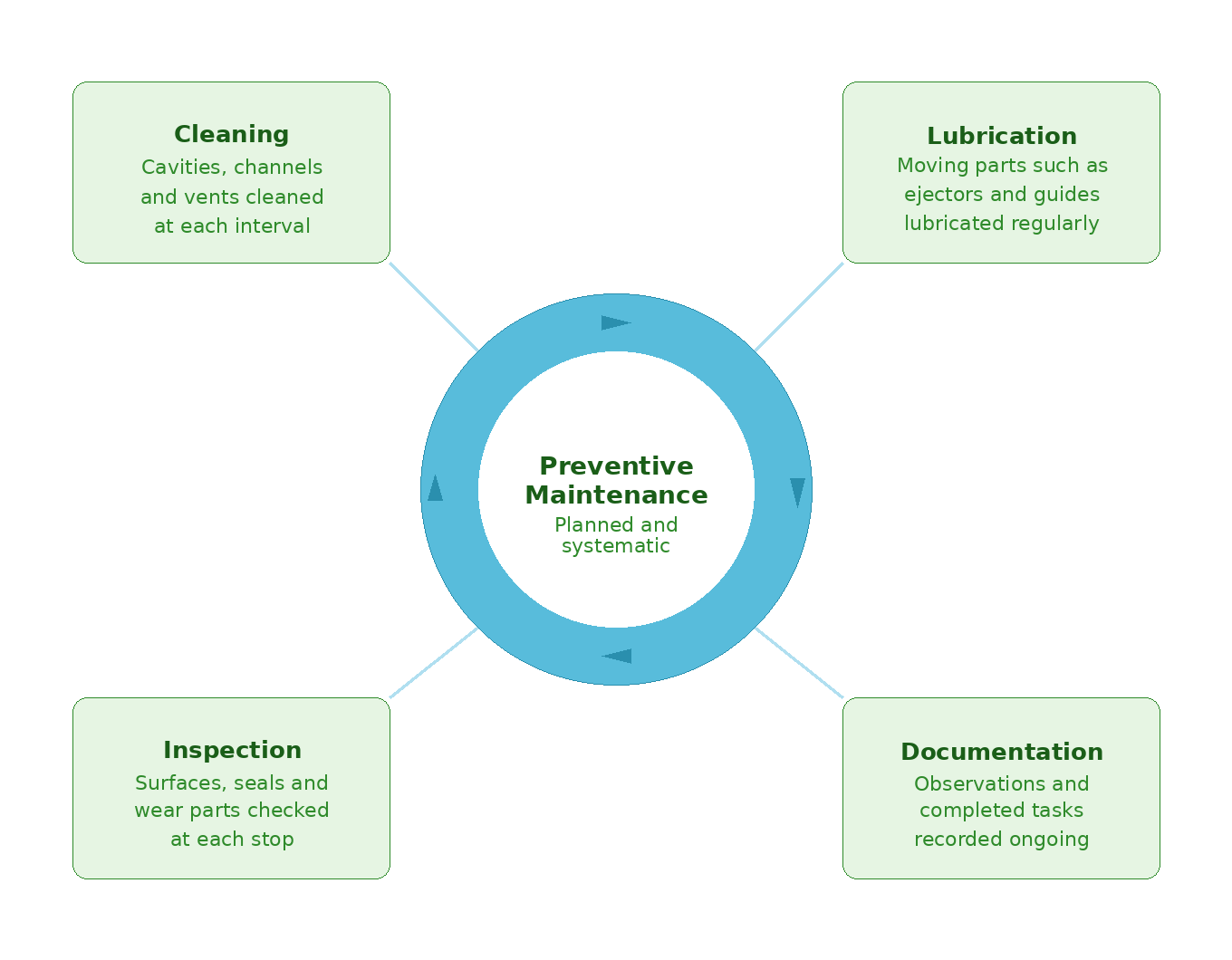
In practice, this includes:
- Cleaning of mould cavities, cooling channels, and vents
- Lubrication of moving parts such as ejectors, guide rails, and cores
- Inspection and verification of wear parts, seals, and surfaces
- Verification of cooling system function and flow
- Documentation of observations and completed tasks
Maintenance that is carried out in a structured and documented manner also provides an important basis for assessing the condition of the tool over time. And how quickly a tool wears out depends largely on the type of steel it is made of. That is the subject of this article: Types of Steel for Injection Molding Tools—Selecting Tool Steel
When Should Maintenance Be Performed?
The timing of maintenance should not solely be determined by the occurrence of visible issues. It should be based on planned intervals defined by:
Cycle Count: The most prevalent method. Maintenance is performed after a predefined number of shots, customized for the specific tool and plastic material.
Time-Based Intervals: Relevant for tools operating for extended periods at low cycle speeds, where time-based intervals are more appropriate than cycle-based ones.
Condition-Based Assessments: In conjunction with planned production changes or upon observing alterations in part quality, cycle time, or surface finish.
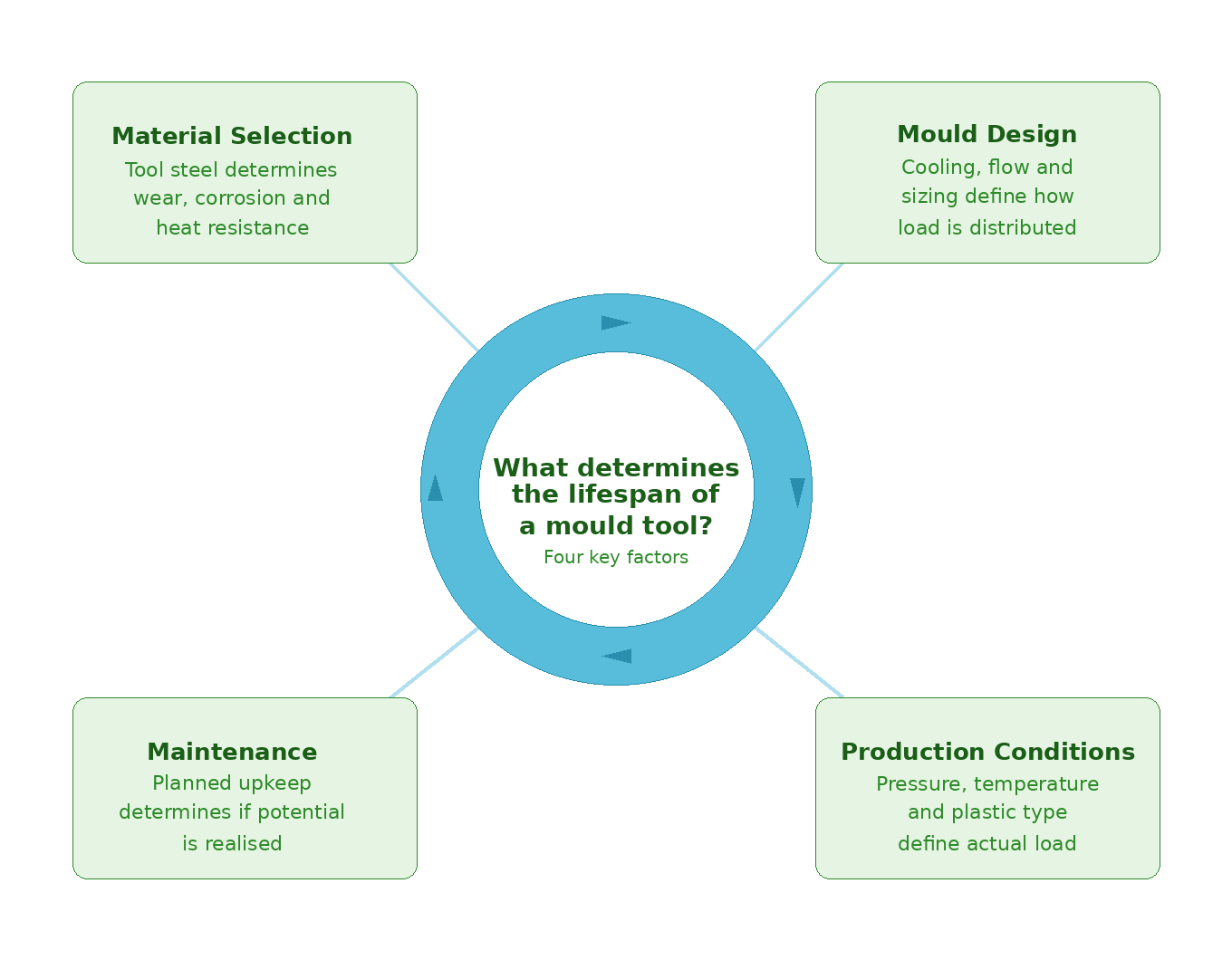
A well-defined maintenance interval is based on specific experience with the particular tool and current production conditions. What can realistically be expected from a given tool is directly related to what determines the lifespan of an injection moulding tool?
Critical Areas to Monitor
Not all components of an injection moulding tool experience uniform wear. Stress is typically concentrated in specific zones, and these areas require the most frequent attention.
Mould Cavities and Cores: Surfaces in direct contact with the plastic material are subjected to wear and thermal stress. Abrasive materials, such as glass fiber-reinforced plastic, significantly increase wear.
Ejection System: Ejector pins and plates are in constant motion and require regular lubrication. Stiffness or wear in these components can lead to faulty ejection and part damage.
Cooling System: Limescale deposits and blockages in cooling channels reduce cooling efficiency, increase cycle time, and can create uneven temperature distribution within the mold. This directly impacts part quality.
Mating and Sealing Surfaces: Wear on mating surfaces can result in flash and dimensional deviations outside of tolerance. Regular inspection and potential post-processing are essential to maintain sealing tolerances.
Vents: Clogged vents lead to burn marks on parts and increased pressure within the mold. Cleaning must be a standard item in the maintenance routine.
Many of these critical areas are directly affected by the design choices made early in the development process. A tool designed for ease of maintenance is easier to maintain and simpler to inspect properly. This is described in more detail in the article: Design for Manufacturing in Injection Molding Tools
Documentation as a Working Tool
Systematic maintenance necessitates systematic documentation. This is not merely for adherence to internal procedures, but because documentation is, in practice, the sole tool providing a comprehensive overview of the tool's condition and history.
A continuous maintenance log should, at a minimum, include:
- Date and number of cycles at the time of execution
- Tasks performed
- Observations regarding wear, damage, or deviations
- Replaced components
This documentation provides a basis for adjusting intervals, identifying patterns, and making informed decisions regarding service life extension or refurbishment. It also forms the basis for the assessments typically conducted in connection with test runs, break-in, and validation of injection molding tools, during which the mold’s actual performance is determined for the first time.
Practical Significance for Production
Companies employing preventive maintenance typically experience fewer unplanned production stoppages, more consistent part quality, and improved predictability in planning.
Conversely, companies that primarily react to problems gradually encounter a situation where the maintenance burden increases, and confidence in production diminishes.
A concrete example: A cooling system that is not regularly cleaned will gradually lose efficiency. This increases the cycle time, but without a clear failure occurring. The consequence is wasted production time over an extended period, rather than a single definable problem.
Preventive maintenance is largely about identifying and addressing the gradual changes that would otherwise go unnoticed in day-to-day production. From an overall economic perspective, ongoing maintenance is almost always less expensive than the consequences of neglecting it. This perspective is explored in more detail in the article: How Much Does an Injection Molding Mold Cost?
Correlation with Lifetime Extension and Refurbishment
Preventive maintenance is not an alternative to lifetime extension or refurbishment; rather, it is the prerequisite for these other initiatives to be effective.
A tool that is not continuously maintained is difficult to assess accurately when the question of lifetime extension arises. Furthermore, a refurbished tool that subsequently operates without systematic maintenance will typically revert to its previous condition more rapidly than necessary.
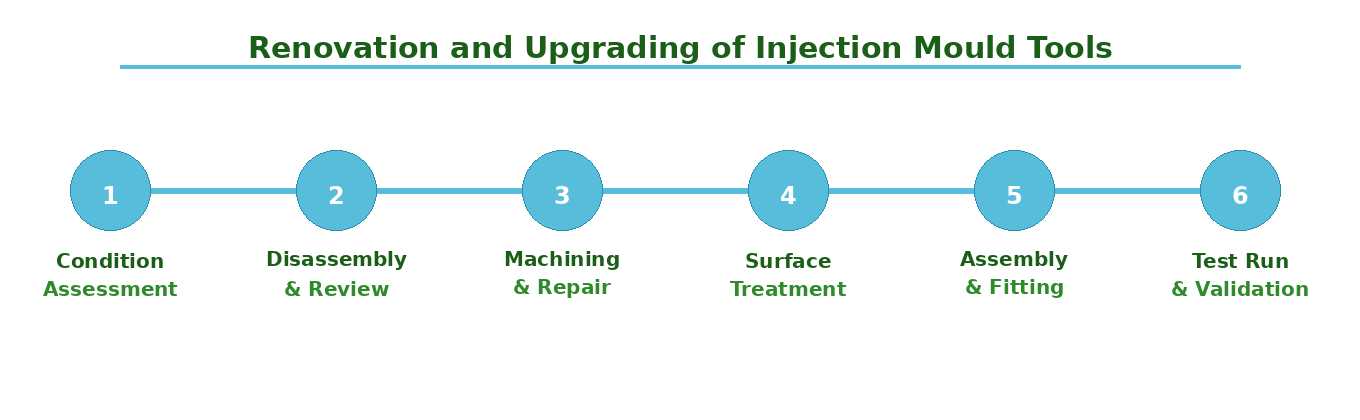
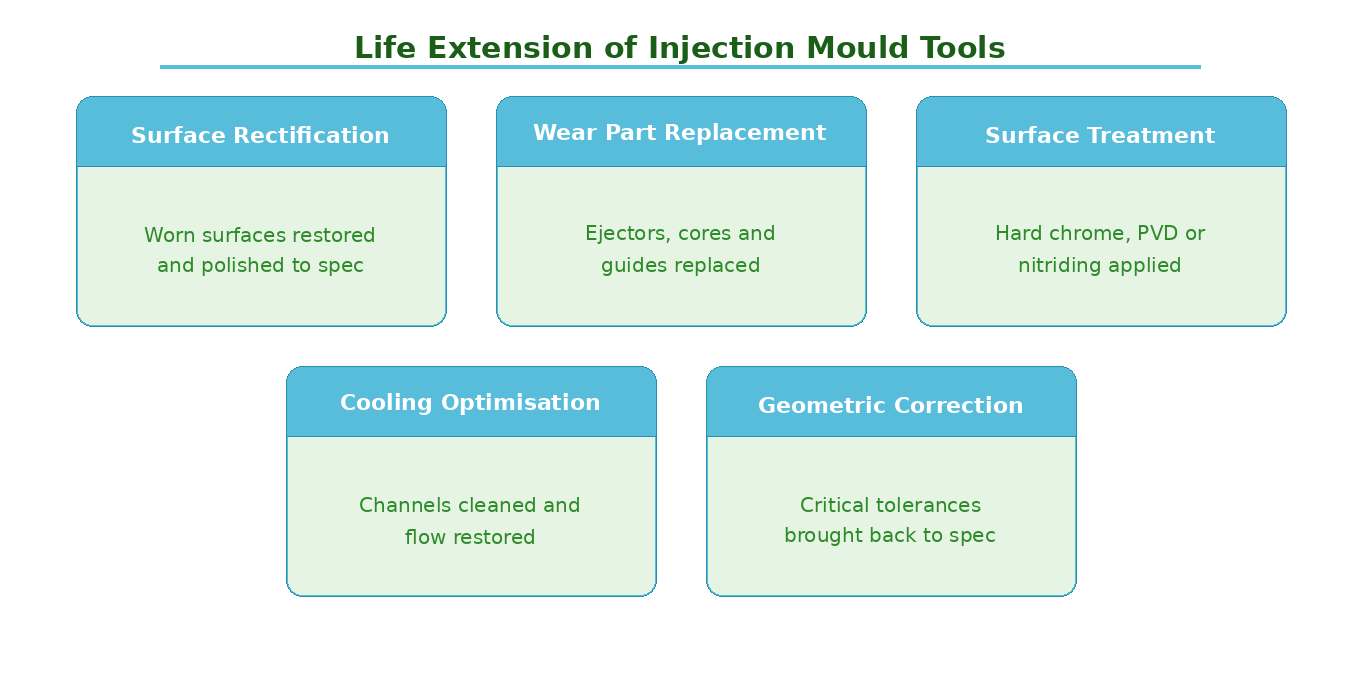
The next logical steps, when maintenance is no longer sufficient, are detailed in these articles: Tool Lifetime Extension and Tool Refurbishment and Upgrades.
Summary
Preventive maintenance is the most direct method to ensure stable operation and extended lifespan for an injection molding tool.
The core principle is to operate proactively rather than reactively, to concentrate efforts on the most stressed areas, and to meticulously document all actions performed and observations made.
Maintenance is not an expense that can be deferred. It is a prerequisite for the investment in an injection molding tool to yield the return for which it was designed.