An injection moulding tool eventually reaches a point where neither ongoing maintenance nor targeted service life extension interventions are sufficient to maintain the required production quality. It can also occur that production requirements change so significantly that the existing tool no longer meets the demand.
In both cases, the question arises: Is refurbishment or upgrading the correct answer, or is a new tool the better solution?
Refurbishment and upgrading are not equivalent to starting anew. They involve a systematic assessment and reconstruction of an existing tool with the objective of restoring or enhancing its performance. The prerequisite is that the fundamental structure remains viable, and that the interventions are well-defined and economically justifiable.
The Distinction Between Refurbishment and Upgrading
These terms are often used interchangeably, but they refer to distinct types of interventions.
Refurbishment focuses on restoring a tool's original performance. It is pertinent when wear, damage, or dimensional deviation has reduced quality below an acceptable threshold. The objective is to return the tool to the condition it was engineered to deliver.
Upgrading involves enhancing a tool beyond its original specifications. This becomes relevant when production requirements have evolved, and the existing tool no longer meets them. This could encompass an increased cavity count, altered geometry, improved cooling, or the integration of new components.
In practice, these two processes are often combined. A tool slated for refurbishment is simultaneously upgraded if production demands have shifted.
When is Refurbishment or Upgrading Applicable?
It is not always evident when the limits of what maintenance and lifespan extension can address have been reached. However, certain typical scenarios make refurbishment or upgrading the logical next course of action.
Extensive Wear: When wear is no longer confined to individual components but is prevalent across mould cavities, cores, mating surfaces, and moving parts, targeted interventions are insufficient. In such cases, a comprehensive refurbishment is more judicious than attempting to resolve issues individually. This scenario differentiates refurbishment from lifespan extension. [INTERN LINK → Lifespan Extension of Injection Moulding Tools]
Altered Production Requirements: If part geometry, material selection, or volume expectations have significantly changed since the original design, upgrading may be the most efficient path forward, rather than investing in an entirely new tool.
Damage from Incidents: Production errors, improper handling, or mechanical incidents can cause damage that necessitates more than routine maintenance. In such cases, a structured refurbishment process is essential to ensure that all consequences of the incident are identified and rectified. Learn more about this topic in the article: Preventive Maintenance of Injection Moulding Tools
Documented Lifespan Limit: A tool that has reached its practical lifespan limit, based on cycles, dimensional deviation, and maintenance history, is a prime candidate for a comprehensive assessment. Gain further insight into this in the article: What Determines the Lifespan of an Injection Moulding Tool?
What Refurbishment Entails
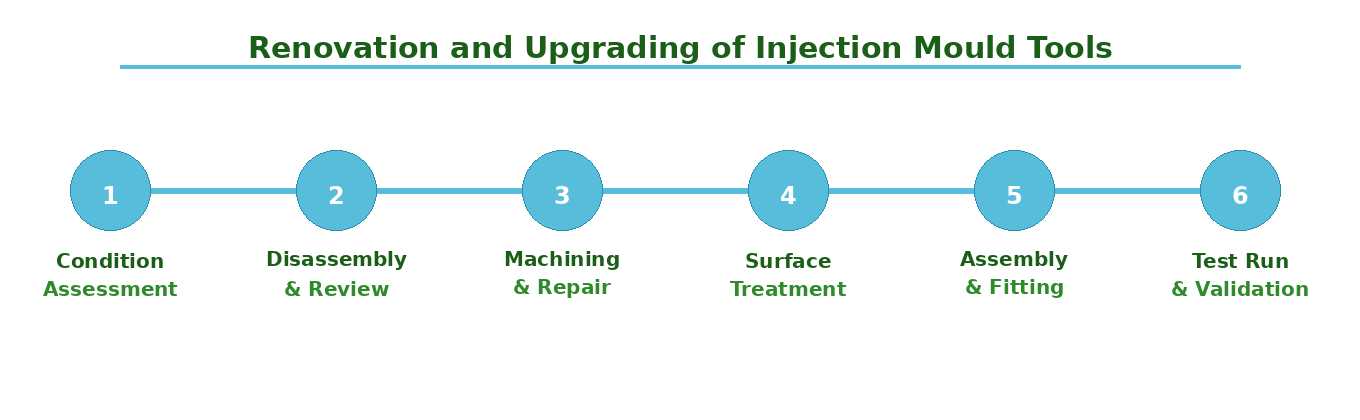
A thorough refurbishment typically follows a structured process, commencing with a condition assessment and concluding with the validation of the refurbished tool.
Condition Assessment and Inspection: Before work commences, the tool's current condition is systematically documented. This includes dimensional measurement of critical tolerances, visual and tactile inspection of surfaces, and a review of maintenance documentation. Without this baseline, precisely defining the scope of the refurbishment is not feasible.
Disassembly and Component Evaluation: The tool is disassembled, and each component is evaluated individually. Some components are reused, others are repaired, and wear parts are replaced. This also provides an opportunity to inspect areas inaccessible during normal operation.
Machining and Rectification: Worn or deformed surfaces are machined to their correct dimensions. This may necessitate welding, subsequent CNC machining, and polishing, depending on the nature of the damage and the requirements for the finished surface.
Surface Treatment: When renovating, it is natural to consider whether surface treatment can increase durability in the future. The choice of treatment depends on the type of steel and the loads to which the tool is exposed. Design for Manufacturing in Injection Molding Tools
Assembly and Adjustment: Once all components are prepared, the tool is assembled, and all mating surfaces, movements, and functions are adjusted. This step demands experience and precision, as the interplay between components is critical for the overall outcome.
Test Run and Validation: The reconditioned tool undergoes a controlled test run, during which workpieces are inspected and measured against specifications. Only when production is stable and within tolerances is the refurbishment considered complete. The same process applies to new tools. Test run, break-in, and validation of injection molding tools
Upgrading as a Constructive Enhancement
Upgrading differs from refurbishment in that it involves constructive modifications to the tool, rather than merely restoring its original condition.
Typical upgrades include:
- Increased cavity count to achieve higher productivity
- Modification of the gating system or cooling configuration for reduced cycle time
- Adaptation of geometry due to product modifications
- Integration of interchangeable inserts to enhance future flexibility
An upgrade requires that the design be thoroughly reconsidered with the new requirements in mind. In principle, this constitutes a partial redevelopment of the mold and should be treated with the same thoroughness as the original design phase. This perspective is described in: Design for Manufacturing in Injection Molding Tools
Economic Evaluation
The decision to refurbish, upgrade, or invest in a new tool is primarily an economic evaluation. While there isn't a singular definitive answer, several factors warrant consideration in this assessment.
Refurbishment is typically the most advantageous solution when:
- The fundamental design is robust and thoroughly documented
- Wear and tear is prevalent but not structurally compromising
- The operational performance requirements for the tool remain unchanged
- The projected remaining service life post-refurbishment can be estimated with reasonable precision
A new mold is often the better investment when production requirements have changed fundamentally, or when the total cost of refurbishment approaches the price of a new mold without offering a comparable service life. The full picture of what a new mold costs is described in: How Much Does an Injection Molding Mold Cost? – Kellpo
Summary
Refurbishment and upgrading become pertinent solutions when routine maintenance and service life extension are no longer adequate, or when production demands have evolved.
A refurbishment restores a tool's original performance through systematic inspection, re-machining, and component replacement. An upgrade, conversely, enhances the tool beyond its initial specifications, necessitating a constructive engineering approach akin to the original development process.
The prerequisite for a successful outcome involves a precise condition assessment, a thoroughly documented maintenance history, and a clear definition of the performance metrics the refurbished or upgraded tool is expected to achieve.
Frequently Asked Questions
Refurbishment restores a tool's original performance by addressing wear and damage. Upgrading, however, enhances the tool beyond its initial specifications, typically in response to altered production requirements.
Refurbishment is generally the most pragmatic solution when the fundamental design remains robust, wear is prevalent but not structurally compromising, and production requirements are stable. If, however, requirements have fundamentally shifted, or if the refurbishment cost approaches that of a new tool, both alternatives warrant thorough evaluation.
A condition assessment encompasses dimensional measurement of critical tolerances, visual and tactile inspection of surfaces and components, and a comprehensive review of maintenance documentation. This forms the basis for precisely defining the scope of the refurbishment.
Yes. In practice, refurbishment and upgrading are frequently combined. When a tool is already disassembled and undergoing re-machining, it is logical to implement enhancements that boost performance or adapt the tool to evolving production requirements.
A refurbishment concludes with a controlled test run and validation, during which components are inspected and measured against specifications. The refurbishment is deemed complete only when production demonstrates stability and adherence to defined tolerances.


