When an injection moulding tool approaches the end of its originally anticipated service life, the decision-making process is rarely straightforward. Should production be maintained as is? Is an investment in a new tool necessary? Or is it possible to extend the life of the existing tool?
In many cases, tool life extension presents the most pragmatic solution. However, this requires a clear understanding of what genuinely limits the tool's current performance and which interventions can specifically address those limitations.
Life extension is distinct from routine maintenance and also differs from a complete refurbishment. It involves targeted technical interventions designed to grant a functional tool an extended productive lifespan.
When is Life Extension Relevant?
Life extension is relevant when a tool remains operational but begins to exhibit signs that its remaining service life is limited without further intervention. Typical indicators include:
- Increasing variation in part quality that cannot be resolved through process adjustments
- Increased need for adjustments and interventions in daily operation
- Visible wear on critical surfaces or moving components
- Altered production requirements demanding higher precision or volume than originally designed for
It is crucial to distinguish these indicators from issues addressed by preventive maintenance. If routine maintenance has proven insufficient to maintain tool stability, it signals a need for more targeted interventions. Read more here: Preventive Maintenance of Injection Moulding Tools
Which Interventions Extend Tool Life?
Life extension encompasses a range of technical interventions tailored to the specific tool's condition and the production requirements it must meet.
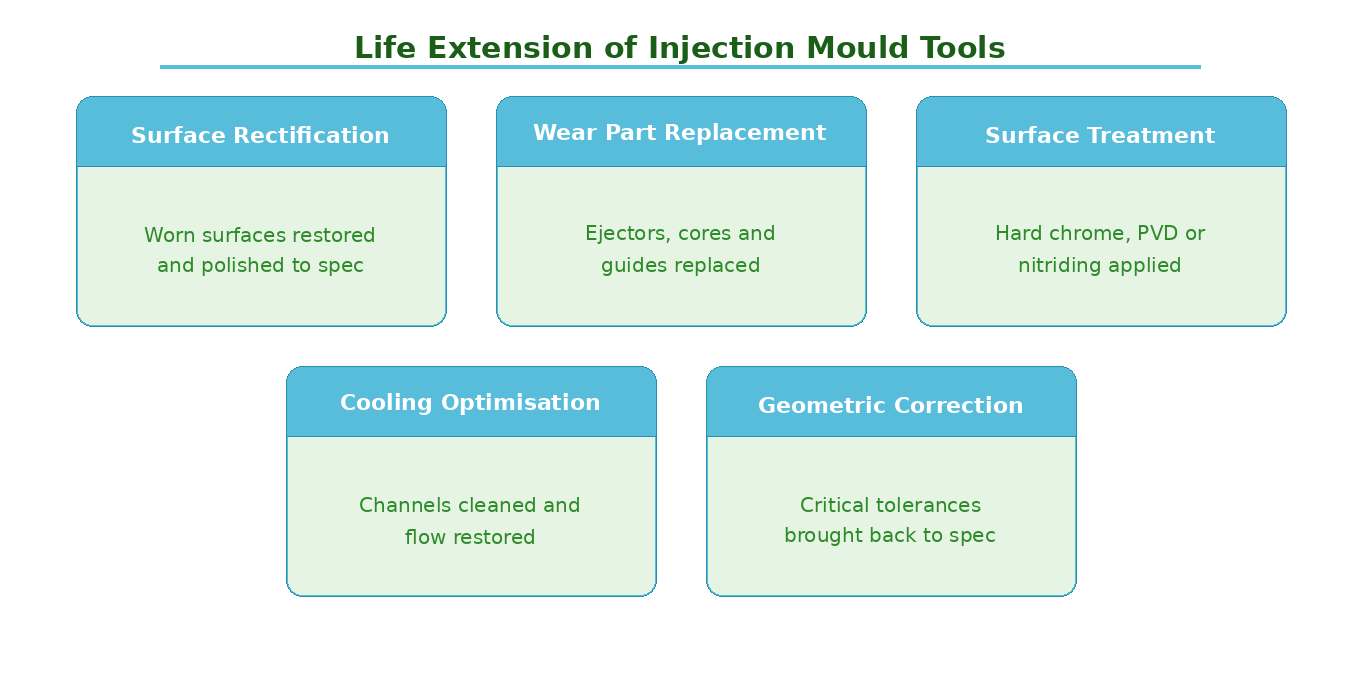
Rectification and Polishing of Mould Surfaces: If a mould surface gradually wears, it will affect the surface quality and dimensional accuracy of the parts. Rectification and subsequent polishing can restore the surface's functionality without necessitating the replacement of the entire insert.
Replacement of Wear Parts: Moving components such as ejector pins, cores, and guide rails are designed for replacement. Systematic replacement of these components before they cause production issues is one of the most effective forms of life extension.
Surface Treatment and Coatings: The application of hard chrome plating, PVD coating, or nitriding can significantly increase surface hardness and reduce future wear. These treatments are particularly relevant if the original steel selection was not optimal for the current plastic material. This is closely related to the topic: [INTERNAL LINK → Steel Types for Injection Moulding Tools – Selection of Tool Steel]
Cooling System Optimization: A cooling system that is no longer performing optimally can often be improved without disassembling the entire tool. Cleaning, rectifying leaks, and in some cases, adding supplementary cooling can significantly enhance both cycle time and part quality.
Geometric Correction of Critical Tolerances: Over time, mating and sealing surfaces can lose the precision they were originally designed with. Targeted machining of these areas can restore tolerances, thereby extending the period during which the tool produces within specification.
Prerequisites for a Successful Intervention
A life-extending intervention is only meaningful if it is based on a precise assessment of the tool's current condition. This requires both a systematic inspection and access to documentation detailing how the tool has been maintained and subjected to load.
Maintenance documentation plays a central role here. Companies that have maintained continuous logs of cycles, observations, and replaced components possess a significantly better basis for assessing which interventions will be effective. You can read more here: What Determines the Lifespan of an Injection Moulding Tool?
A comprehensive inspection should identify:
- Degree of wear on mould cavities, cores, and moving parts
- Condition of the cooling system and any deposits
- Dimensional accuracy in critical tolerances
- Any cracks, deformations, or surface damage
Without this foundation, there is a risk of implementing interventions that do not address the actual limitations.
Lifespan Extension from an Economic Perspective
The decision to extend the lifespan of an existing tool should always be evaluated against the alternative: investing in a new tool.
Lifespan extension is typically the most cost-effective solution when:
- Interventions are limited and well-defined
- The tool's fundamental construction remains robust
- Production requirements have not fundamentally changed
- There is a clear estimate of the remaining lifespan the interventions will provide
If, on the other hand, production requirements have changed significantly, or if wear is widespread throughout the mold, a new mold may be the more sensible investment in the long run. The full financial picture is described in: How Much Does an Injection Molding Mold Cost?
The Boundary with Refurbishment
There is no sharp distinction between lifespan extension and refurbishment, but a practical differentiation is useful.
Lifespan extension involves targeted interventions on specific components or surfaces within an otherwise functional tool. Refurbishment, however, is a more extensive intervention, typically relevant when wear is widespread, geometry is compromised, or structural modifications are required.
When targeted interventions are no longer sufficient, the next step is described in: Renovation and Upgrade of Tools
Relationship with Design Choices
It is worth noting that the possibilities for lifespan extension are largely determined by the choices made during the tool's initial design and construction.
A tool designed with interchangeable inserts, service-friendly access to critical zones, and robust dimensioning of stressed areas is significantly easier to maintain when the need for life-extending interventions arises.
This is one of the reasons why the design phase is so important to the product’s entire life cycle. This is the subject of: Design for Manufacturing in Injection Molding Tools
Summary
Lifespan extension involves identifying the actual limitations on a tool's remaining performance and addressing these constraints with targeted technical interventions.
The most commonly employed methods include surface rectification, replacement of wear parts, surface treatments, and optimization of the cooling system. The prerequisite for a successful intervention is a precise condition assessment based on inspection and documentation.
Service life extension is not applicable in all situations. However, in cases where the fundamental structure remains sound and the interventions are well-defined, it typically represents the most cost-effective method for maintaining production capacity.
Frequently Asked Questions
Service life extension involves targeted technical interventions that restore or enhance a tool's performance without requiring a full renovation. This may include surface rectification, replacement of wear parts, and the application of protective coatings.
Service life extension is typically relevant when the fundamental structure remains sound, interventions are limited, and production requirements have not fundamentally changed. A new tool is often the more appropriate solution if wear is extensive or requirements have changed significantly.
Preventive maintenance involves ongoing, planned efforts to preserve the condition of a well-functioning tool. Service life extension, however, consists of more targeted interventions designed to restore performance that has started to decline despite continuous maintenance.
The most commonly used are hard chrome plating, PVD coating, and nitriding. All three increase surface hardness and reduce future wear. The selection depends on the plastic material, applied load, and the original steel specification.
It depends on the scope of the intervention. The replacement of wear parts can often be scheduled during planned production shutdowns. More extensive interventions, such as surface treatment or geometric correction, typically require the tool to be taken out of service for a shorter period.


