The service life of an injection moulding tool is not a fixed value. It depends on a range of technical choices and operational conditions, which collectively determine how long the tool can produce stably and within the desired tolerances.
For companies involved in plastic production, service life is therefore not solely about durability. It also encompasses product quality, uptime, maintenance requirements, and overall economics.
To effectively manage maintenance, extend service life, and undertake potential refurbishment, it is first necessary to understand what truly impacts the service life.
Service Life Is Not Solely About Shot Count
The service life of an injection moulding tool describes the period during which the tool can produce parts within the specified quality requirements.
A distinction is often made between theoretical service life and practical service life. Theoretical service life is based on design, material selection, and anticipated application. Practical service life depends on how the tool is actually stressed and maintained during production.
In practice, service life is often measured in cycles, but the critical factor is not solely the number of shots. The crucial aspect is how long the tool can consistently deliver uniform quality without a disproportionate number of stops, adjustments, or repairs.
Material Selection Establishes the Baseline
The choice of tool steel significantly impacts the tool's resistance to wear, corrosion, and thermal stress. In other words, the material establishes the fundamental potential for its service life.
Some steel types are better suited for high wear resistance, others for corrosion resistance or high polishability. Consequently, there is no single tool steel that is universally correct for all applications. The optimal choice depends, among other factors, on the part's geometry, the plastic material, the anticipated production volume, and the requirements for surface finish and precision.
If you’d like to read more about this, the topic is closely related to the article: Steel Types for Injection Molding Tools – Selecting Tool Steel
Design Determines Load Distribution
Even the correct steel cannot compensate for a tool that is inadequately designed. The design significantly influences how loads are distributed during production, and consequently, how quickly the tool experiences wear.
Cooling, material flow, venting, ejection, and the dimensioning of critical areas all play a role. If heat, pressure, or wear concentrates in specific zones, these areas will typically begin to exhibit issues before the rest of the tool.
It is also during the design phase that practical decisions are made regarding the tool's future serviceability. Therefore, service life is closely linked to the choices made early in the development process.
These topics are explored in greater depth in: From Idea to Finished Injection Molding Mold and Design for Manufacturing in Injection Molding Tools
Production Conditions Determine the Actual Load
A tool's service life cannot be assessed in isolation from the process in which it operates. The actual production conditions significantly influence how severely the tool is stressed over time.
Cycle time, temperature, pressure, and the choice of plastic material all influence wear. Particularly filled or abrasive materials, such as glass-fiber reinforced plastic, can significantly increase wear. High temperatures and numerous thermal cycles can also contribute to the accelerated degradation of critical components.
This implies that two tools, starting from the same baseline, can experience vastly different service lives if operated under varying process conditions.
Maintenance Determines if the Potential is Realized
While material selection and design establish a tool's potential, maintenance often dictates whether that potential is realized in practical application.
Ongoing maintenance directly impacts the duration for which a tool can deliver consistent quality. This encompasses cleaning, lubrication, inspection of wear parts, and critical area assessments.
Many significant issues do not emerge abruptly. They evolve gradually due to incipient wear or imbalance not being detected and addressed promptly. Therefore, maintenance is not merely an operational task; it is also a pivotal factor in the tool's overall service life.
The practical approach to this is detailed in the following article: Preventive Maintenance of Injection Moulding Tools.
Service Life is the Result of an Interplay
Consequently, the key is not to identify a singular explanation for service life. Instead, service life emerges from the interplay of multiple factors.
A tool with robust material and optimal design may experience a reduced service life if subjected to demanding operation and inadequate maintenance. Conversely, a tool with more moderate specifications can endure for an extended period if production is stable and maintenance is systematic.
Therefore, service life should always be assessed holistically. Focusing solely on the steel overlooks the significance of design. Similarly, concentrating only on maintenance disregards decisions already made during the development phase.
As the Tool Approaches its Practical Service Life
When a tool approaches the end of its practical service life, it often manifests as increased wear, nascent variations in part quality, or a more frequent need for adjustments.
At that juncture, service life transcends being merely a technical inquiry and becomes a strategic decision-making point.
Typically, three potential courses of action emerge. The first involves maintaining stable operation through robust preventive maintenance. The second entails targeted interventions aimed at extending the service life. The third is a more comprehensive refurbishment, necessitated by wear or evolving requirements.
The latter two approaches are detailed in Tool Service Life Extension and Tool Refurbishment and Upgrades.
Summary
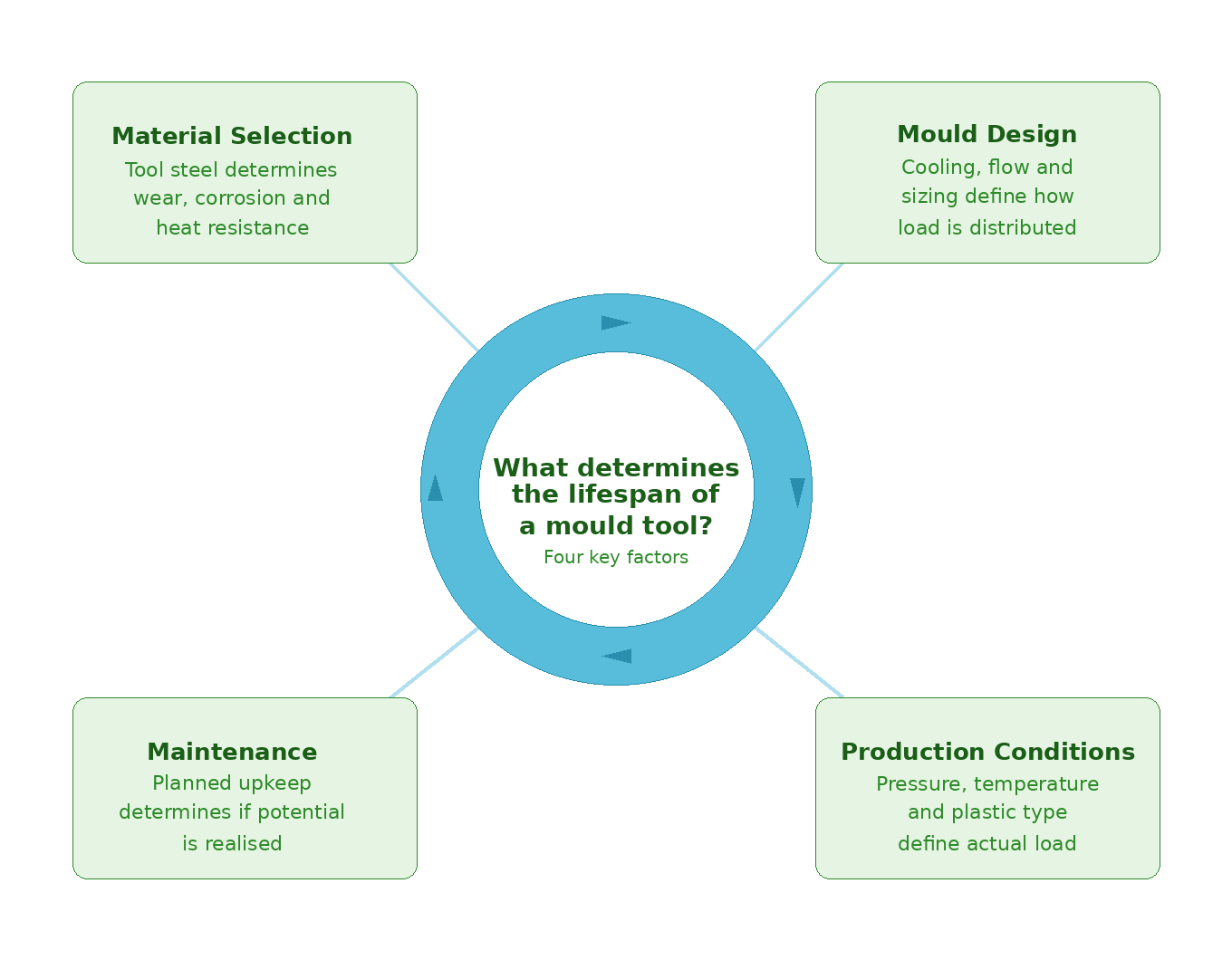
The service life of an injection moulding tool is not determined by a singular factor. It arises from the interplay of material selection, design, production conditions, and maintenance.
The material establishes the fundamental potential. The design dictates how loads are distributed. Production conditions determine the actual wear. And maintenance determines whether that potential is realized in practice.
Understanding this interplay is a prerequisite for effectively addressing maintenance, service life extension, and refurbishment.
Frequently Asked Questions
This varies significantly. Some tools are engineered for shorter production runs, while others must endure millions of cycles. It is contingent upon material selection, design, production conditions, and maintenance.
It is rarely a singular factor. More often, it is a combination of high stresses, abrasive materials, suboptimal design, and inadequate maintenance.
Yes, in many instances. However, it depends on the actual limiting factors for service life. This topic is addressed in Tool Service Life Extension.
Refurbishment becomes relevant when wear begins to impact the quality, stability, or economic viability of production. This topic is further elaborated in 'Refurbishment and Upgrading of Tools'.
Do you have a tool where lifespan is a concern?
If a tool exhibits signs of wear, unstable operation, or escalating maintenance requirements, it is crucial to evaluate the factors genuinely limiting its operational lifespan.
At Kellpo, we assist in assessing the tool's condition and determining whether the optimal approach involves maintenance, lifespan extension, or refurbishment. Refurbishment and Upgrading of Tools


