The cost of an injection-molding tool is one of the questions most frequently asked early in a project, and one of the hardest to answer without concrete information.
This is not because prices are arbitrary or opaque. It is because the price of an injection-molding tool depends directly on a number of technical and production-related decisions that vary significantly from project to project.
Realistic pricing expectations therefore require an understanding of what drives costs.
This article reviews the most important parameters, what they mean in practice, and how customers can best prepare for price negotiations.
What determines the price?
The cost of an injection molding tool is the sum of the resources required to design, manufacture, and validate it.
The most important factors are:
The Complexity of the Part
The more complex the geometry, the more time is required for design, CNC machining, and EDM. Undercuts, clamping solutions, and complex internal profiles significantly increase the cost. Read more about this topic in the article: Design for Manufacturing in Injection Molding Tools
Number of Cavities
A multi-cavity mold is more expensive to manufacture than a single-cavity mold, but produces more parts per cycle. The choice of the number of cavities depends on the expected production volume and the trade-off between the investment in the mold and the ongoing unit costs. Single-cavity vs. multi-cavity molds
Tolerances and Surface Requirements
Tight tolerances require precision machining and more time in the manufacturing process. High surface quality requirements—such as mirror polishing for optical components or a textured finish for design products—also require specialized finishing.
Steel Grade
The choice of steel affects both the manufacturing cost and the tool’s service life. A high-alloy performance steel for high-volume production is more expensive than a standard steel for prototypes or low-volume production, but offers a significantly longer service life. Read more about selecting steel here: Steel Types for Injection Molding Tools – Selecting Tool Steel
Injection System
In the vast majority of cases, a hot runner system is used, which reduces material waste and shortens cycle times. A hot runner system requires a higher initial investment than a cold runner system, but is typically the better solution over the mold’s entire service life.
Size
Larger workpieces require larger steel blocks, larger machines, and more machining time. However, size alone is rarely the deciding factor, as complexity carries more weight than raw dimensions.
How much can an injection molding mold cost?
The price range for injection molding tools is very wide. A simple single-cavity mold for an uncomplicated part can cost between 50,000 and 150,000 kr. A complex multi-cavity mold with tight tolerance requirements, clamping solutions, and a hot runner system can cost 500,000 kr. and up.
These figures are for guidance only and cannot replace a specific assessment based on project data and requirements specifications. However, they illustrate the range and emphasize that the price is the result of technical choices, not a fixed amount.
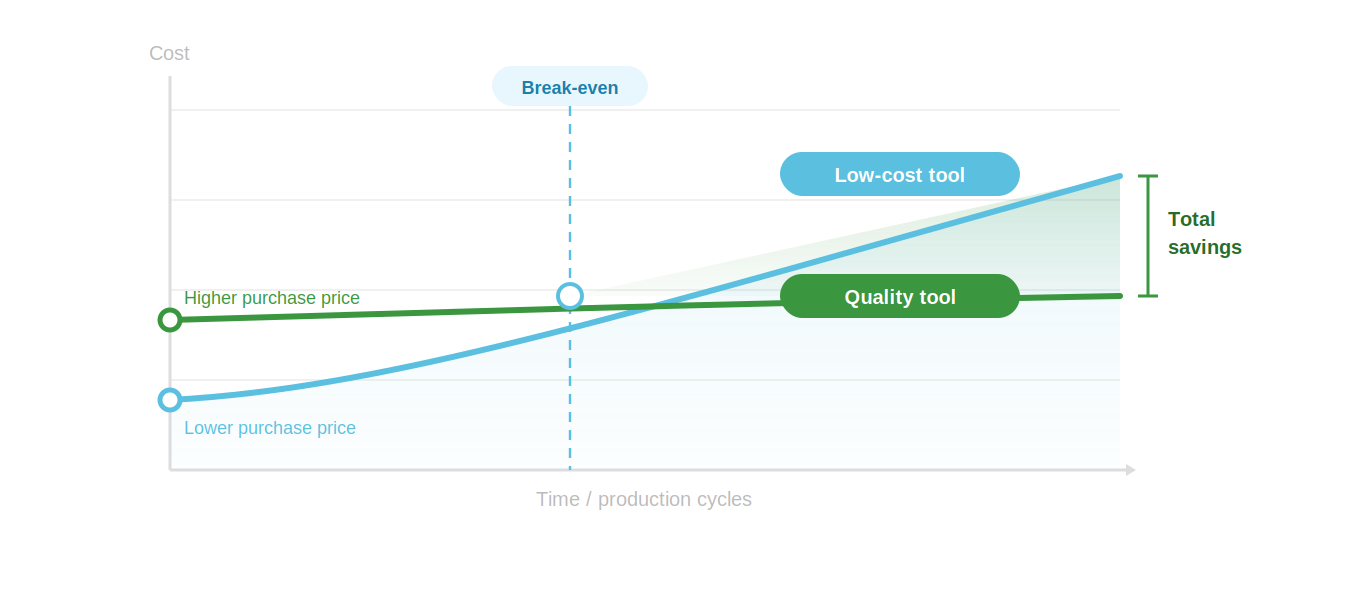
Total cost rather than purchase price
An experienced buyer does not evaluate the price of an injection molding tool in isolation. The relevant figure is the total cost over the tool’s service life, which includes:
- The purchase price of the tool
- Ongoing maintenance costs
- Unit price of the produced items
- Expected service life and number of cycles
- The risk of unplanned downtime and repairs
An inexpensive tool that requires frequent maintenance, has a shorter service life, and produces a higher scrap rate is rarely the cheapest solution over time.
What factors influence the price in the early stages?
The decisions that have the greatest impact on the price are not made by the toolmaker. They are made by the person who designs the workpiece.
Part design, material selection, and tolerance requirements define the parameters of what a mold must be capable of. A DfM review early in the process is therefore not just good practice—it is the most effective way to ensure that the price reflects what is actually necessary, rather than paying for complexity that could have been avoided. Read more about how to do this in the article: From Idea to Finished Injection Molding Mold.
How to Prepare for a Price Discussion
To get an accurate and comparable quote, it’s helpful to have the following information ready:
- 3D model and 2D drawings with tolerances
- Material Requirements Specification
- Expected annual volume and total lifetime volume
- Surface and Finish Requirements
- Documentation and validation requirements, including whether IQ, OQ, or PQ are required [INTERNAL LINK → Test Run, Commissioning, and Validation]
- Desired delivery time
The more complete the information is, the more accurate the quote will be, and the easier it will be to compare quotes from different suppliers on a realistic basis.
Summary
The price of an injection molding mold is determined by the complexity of the part, the number of cavities, tolerance requirements, choice of steel, gate system, and size. There is no standard price because there is no such thing as a standard mold.
The key point is that the price is largely determined during the design phase. Decisions regarding workpiece geometry, material selection, and tolerances have a direct and measurable impact on the cost of a finished tool and its operating costs over time.
Frequently Asked Questions
The price varies significantly depending on complexity, the number of cavities, and requirements. A simple single-cavity mold can start at 50,000 kr., while complex multi-cavity molds can cost 500,000 kr. or more. An exact price requires a specific assessment based on part data.
The complexity of the part is typically the most decisive factor. Undercuts, clamping solutions, and tight tolerances significantly increase design and machining time.
Not necessarily. A lower purchase price may be offset by higher maintenance costs, a shorter service life, and a higher unit price. The total cost over the service life is the relevant basis for comparison.
An accurate quote requires a 3D model, 2D drawings with tolerances, material specifications, and the expected volume. The more complete the information provided, the more accurate and comparable the quote will be.
Yes. A hot-runner system requires a higher initial investment than a cold runner, but it reduces material waste and results in shorter cycle times. Over its lifetime, it is typically the better and more cost-effective solution.


