The rPET Market in Europe

The rPET Market in Europe: Supply, Capacity, and Competition for Food-Grade Material

PET’s compliance path under the PPWR rests on a single assumption: that there will be sufficient food-grade recycled PET (rPET) available on the European market in 2030 to meet the 30% requirement in Article 7. This is a prerequisite that market data from 2024 and 2025 seriously call into question.

The European rPET market is not a single market—it is a hierarchy of applications with very unequal access to the limited supply of food-grade recycled material. PET bottles dominate the recycling infrastructure. Non-bottle applications—including trays, cups, and dairy product containers—are structurally at the bottom of this hierarchy as price takers in a contracting market.

This article describes the current state of the rPET market, the structural capacity constraints, and the competition for food-grade rPET resulting from the fact that two EU directives—the SUP Directive and the PPWR—impose simultaneous requirements on the same limited material stream. PP or PET by 2030? The regulatory and supply-side asymmetry.

The European rPET Market: Capacityand Structure

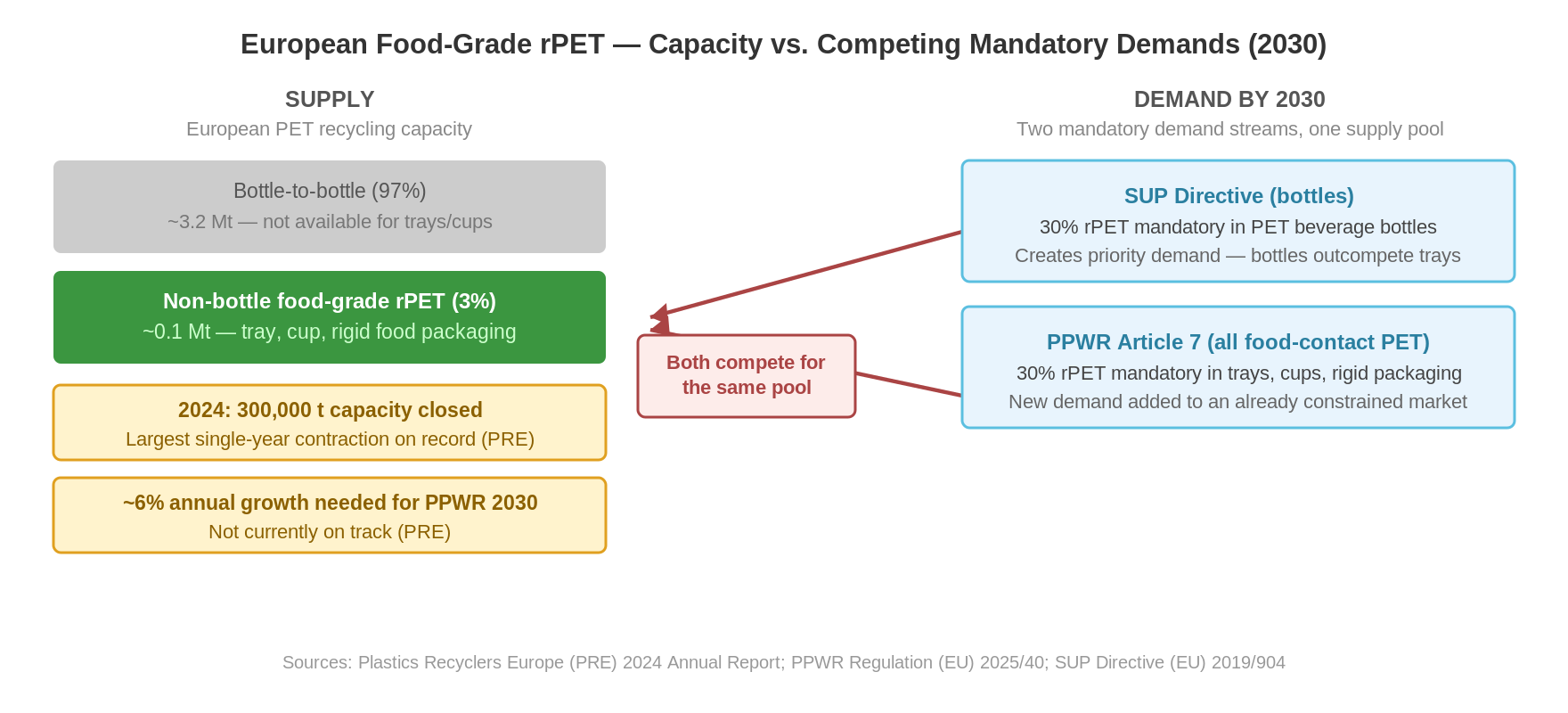
PET recycling in Europe is dominated by bottle recycling. Total European PET recycling capacity is estimated at approximately 3.3 million metric tons, the majority of which is configured to receive and process collected PET beverage bottles and convert them into food-grade rPET flakes or pellets for bottle production.

The capacity to produce food-grade rPET for non-bottle applications—including trays for dairy products, cups, bowls, and other rigid packaging—is estimated at less than 0.1 million metric tons, corresponding to less than 3% of total European capacity. The technology for producing food-grade rPET suitable for trays is well established, but the industrial infrastructure—sorting facilities configured for tray fractions and recycling plants with food-contact approval for tray input—is far more limited than the infrastructure for bottles.

The absence of a dedicated tray-to-tray recycling stream means that manufacturers of PET trays and cups are, in practice, competing for bottle-grade rPET that is remolded for tray applications. This is a market with lower efficiency and higher costs than the bottle-to-bottle stream—and one that is typically given lower priority when recycling facilities optimize for volume and margin.
Capacity Contraction and Market Signals

In 2024, the European PET recycling industry shut down capacity equivalent to approximately 300,000 metric tons—the largest single-year contraction since the industry’s inception. The cause was a combination of falling demand, import competition from cheaper rPET pellets from Asia, and lower virgin PET prices, which put pressure on rPET margins. The industry organization Plastics Recyclers Europe (PRE) reports a 5.5% decline in revenue for the European recycling industry as a whole.

PRE has identified food-contact rPET as the segment under the greatest pressure and has pointed out that the growth in recycling capacity needed to meet the PPWR’s 30% requirement by 2030 requires approximately 6% annual capacity growth—a level of growth that, according to PRE’s analyses, is not currently underway.

In March 2026, Indorama Ventures—one of Europe’s largest PET and rPET producers—declared force majeure on shipments, leading to subsequent shutdowns in preform production at dependent customers. This is a single incident, but it illustrates the vulnerability of a supply chain that is already under structural pressure.

Structural Competition: The SUP Directive Meets the PPWR

What makes the European rPET situation unique as we look toward 2030 is not only that capacity is limited—it is that two separate EU regulatory instruments impose simultaneous requirements on the same supply source.

The SUP Directive (Single-Use Plastics Directive) requires a 25% recycled content in PET beverage bottles starting in 2025, rising to 30% by 2030. This requirement specifically affects bottle manufacturers and creates structural, mandatory demand for food-grade rPET for bottle applications. Bottle manufacturers are actively purchasing rPET to meet SUP requirements—and they are willing to pay a premium for certified food-grade material.

Article 7 of the PPWR requires 30% rPET in all food-contact PET packaging starting in 2030—including trays, cups, and bowls that are not beverage bottles. This is a new and separate demand placed on the already limited food-grade rPET capacity. As a result, bottle manufacturers and tray/cup manufacturers are competing for material from the same recycling ecosystem. Bottle manufacturers are structurally better positioned in this competition: they purchase in higher volumes, they compete for a more standardized material, and they are driven by mandatory regulatory demand that gives them an incentive to pay above the spot price.

Contractual rPET Allocation and Supplier Risk

For a brand owner planning to use PET packaging that complies with rPET standards by 2030, it is not enough to simply know that the rPET market exists. The question is whether it is possible to secure a contract-based, documented supply arrangement that will last through 2030 and beyond.

The relevant questions to ask a potential rPET supplier are: Is the allocation for food-contact applications contractually specified and not merely indicative? What backup supply partners are available if the primary supplier experiences capacity shortages, price volatility, or force majeure? What is the supplier’s plan for Article 7 compliance—and is it contingent on the implementing act decisions under Article 7(8)?

Market signals from 2024 and 2026 suggest that the answers to these questions will, in many cases, reveal a shorter and more vulnerable supply chain than what appears on paper to be a straightforward compliance solution.

What the Market Says About PP

The rPET market situation is not directly relevant to PP packaging—there is not yet an established European market for food-grade rPP on an industrial scale. But it is precisely the absence of this market that triggers PP’s exemption under Article 7(5)(a): if there is no industrial recycling capacity, the manufacturer may seek an exemption. The challenge for PP is not a market under pressure—it is a market that has not yet been established, and for which the regulation explicitly allows time to develop.

For PET, the situation is the opposite: the market exists, the Commission has determined that it can meet the demand—and the exemption option under Article 7(5)(a) and the derogation mechanism under Article 7(12) are therefore not available for PET. The European rPET market is currently experiencing a period of contraction and competitive pressure, and it is within this market that PET packaging manufacturers must find their compliance solution leading up to 2030. PP or PET leading up to 2030? The regulatory and supply-side asymmetry.


Summary

The European rPET market is structurally dominated by bottle recycling, with less than 3% of total capacity dedicated to non-bottle food-contact applications. Plastics Recyclers Europe (PRE) documented the closure of 300,000 metric tons of capacity in 2024 and identified food-contact rPET as the segment under the most pressure. The capacity growth of approximately 6% annually required to meet the PPWR’s 2030 requirements has not yet begun. Added to this is structural competition from the SUP Directive’s simultaneous requirement for 30% rPET in PET beverage bottles starting in 2030—a mandatory demand that competes directly for the limited food-grade rPET capacity. For tray and cup manufacturers planning to use PET-based packaging, the security of the rPET supply is an active commercial and contractual issue—not a given prerequisite.

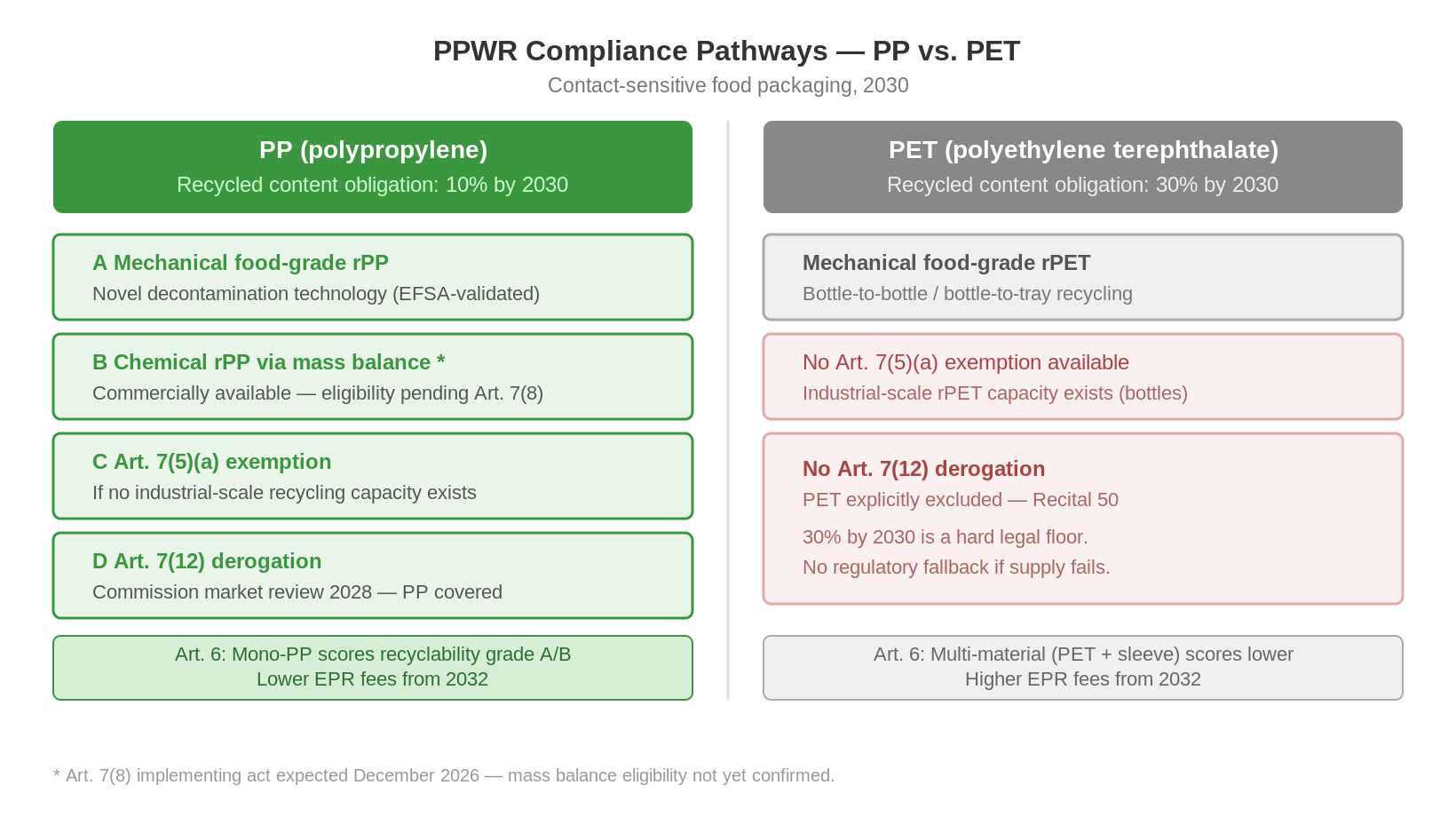
PP or PET by 2030? The Regulatory and Supply Asymmetry

For a company that is currently selecting materials for plastic packaging for the European market, PPWR is not just a matter of what the law requires. It is a matter of what risk profile the chosen material carries looking ahead to 2030—and who bears that risk.

PP and PET are both well-established materials for food packaging. However, under the PPWR, the two materials are in very different positions. PP is subject to a lower recycling requirement, has four documented compliance pathways, and is covered by the regulation’s derogation provision. PET faces a requirement three times higher by 2030, has effectively only one unconditionally approved compliance pathway today, and is explicitly excluded from the safety valve that PP can activate in the event of a supply disruption.

This article compares the regulatory and supply situations for PP and PET under the PPWR. The requirements for recycled content by material type are described in Recycled Content in Plastic Packaging Under the PPWR—Requirements, Timeline, and Material Differences. The supply market for rPET is reviewed in The rPET Market in Europe

Two materials, two different regulatory profiles

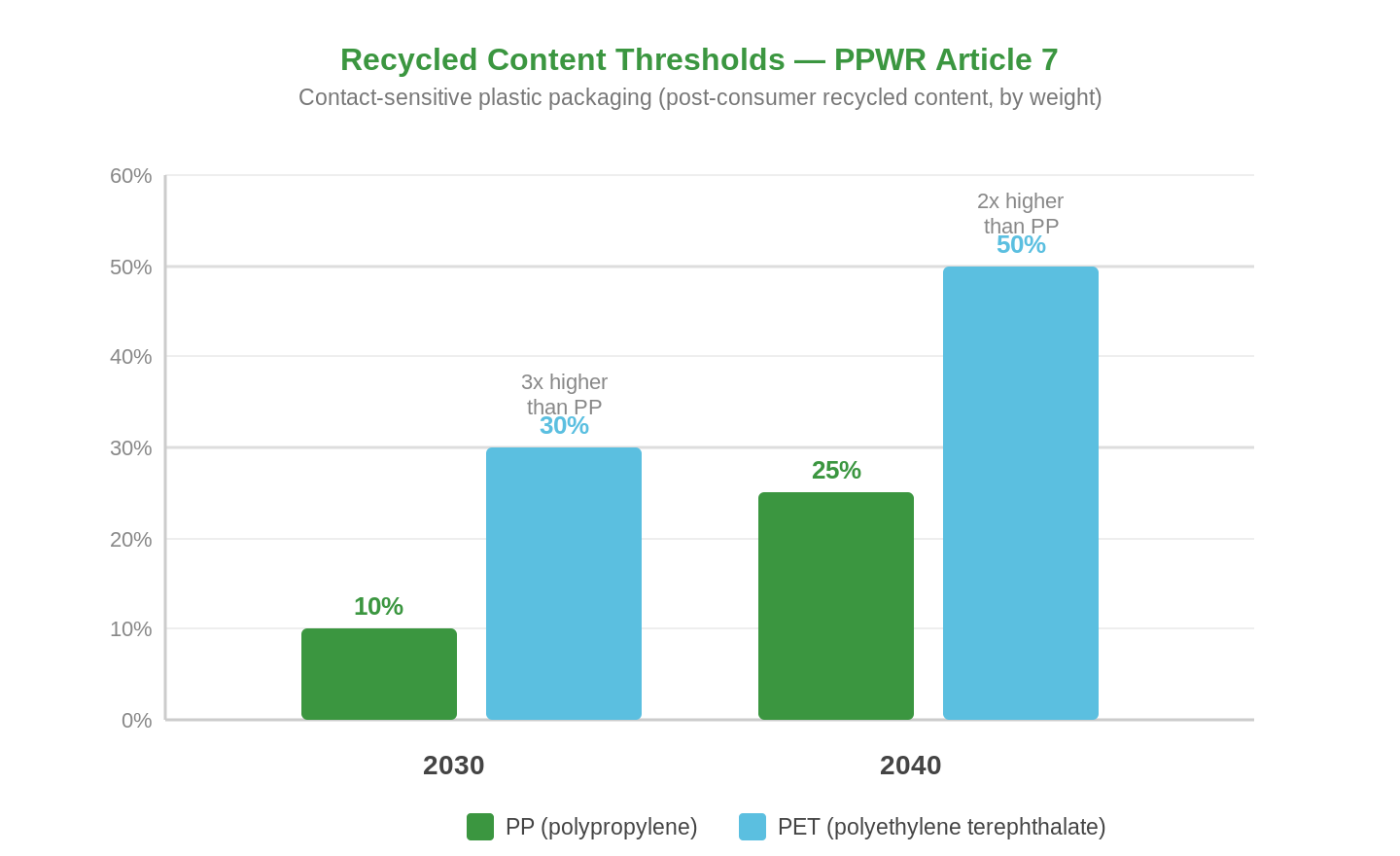
The starting point is the requirements set forth in Article 7. For PET packaging that comes into contact with food, the requirement is 30% post-consumer recycled content starting in 2030, rising to 50% in 2040. For PP, the requirement is 10% starting in 2030 and 25% starting in 2040. The difference is not marginal—the PET requirement is three times that of PP in 2030 for the same type of contact-sensitive packaging.

But the asymmetry does not stop at the threshold levels. It continues in the regulation’s framework for what happens if the market cannot deliver. Article 7(12) allows the Commission to postpone the compliance deadline for PP and other non-PET plastic types based on a market review in 2028. PET is explicitly exempt from this provision—not as an oversight, but as a deliberate legislative choice articulated in Recital 50. For a packaging buyer, the implication is simple: PP has a fallback; PET does not.

In addition, under Article 7(5)(a), PP may seek an exemption from the requirement if there is no industrial recycling capacity on a sufficient scale. This exemption does not apply to PET—there is industrial recycling capacity for PET bottles, and the Commission has determined that the market can supply the required volume.

PP’s Four Paths to Compliance by 2030

PP’s regulatory profile is not only favorable in terms of the threshold level—it is favorable because PP has four documented ways to meet its obligations.

The first approach involves mechanically recycled food-grade PP produced using newly developed super-purification technology. The technology has been validated by EFSA and is commercially available—though not yet on an industrial scale for all European markets. European development initiatives in the field of mechanically recycled food-grade rPP are currently being scaled up.

The second route is chemically recycled PP via mass balance allocation. Processes based on the pyrolysis of plastic waste can currently supply rPP through certification schemes such as ISCC+. The material is commercially available. Whether it qualifies as post-consumer recycled content under the PPWR will be determined by the implementing act under Article 7(8), which is expected in December 2026.

The third option is the exception under Article 7(5)(a): if there is no industrial recycling capacity for food-grade rPP on a sufficient scale, the manufacturer may apply for an exemption by providing supporting documentation. This provision is specifically designed for situations such as that of PP today—a material with a growing recycling ecosystem, but not yet at an industrial scale.

The fourth option is the safety valves provided for in Article 7(12) and 7(13): the Commission’s ability to defer the requirement for PP based on the 2028 market review, and the general emergency clauses that can be activated in the event of documented supply crises.

PET’s Supply Challenge: One Path, One Market

PET’s compliance framework is simpler than PP’s—and more vulnerable. The path to 30% rPET by 2030 lies primarily in the mechanical recycling of collected PET into food-grade rPET. This is the only route that is currently unconditionally approved under the PPWR.

The challenge is that this market is under pressure. According to data from Plastics Recyclers Europe (PRE), the European PET recycling industry shut down 300,000 metric tons of capacity in 2024—the largest capacity reduction ever—as a result of pressure from cheap imported rPET pellets and falling virgin PET prices. PRE identifies food-contact rPET as the segment under the most pressure and emphasizes that the approximately 6% annual capacity growth needed to meet PPWR requirements is not currently underway.

In addition, there is structural competition for the limited food-grade rPET capacity. PET bottles are subject to the SUP (Single-Use Plastics) Directive, which requires 25% rPET in PET beverage bottles starting in 2025 and 30% starting in 2030. Bottle manufacturers and tray manufacturers compete for the same supply source. For non-bottle PET packaging—including trays and cups—specific recycling capacity accounts for less than 3% of total European PET recycling capacity, according to available market data.

The regulatory asymmetry in Article 7(12)

The most underestimated aspect of the integration of PP and PET in a PPWR is not the threshold level—it is what happens in the event of a supply failure.

Article 7(12) stipulates that the Commission must conduct a market review by 2028 at the latest and, based on that review, may decide to postpone the compliance date for specific material categories if insufficient supply capacity is demonstrated. PP and other non-PET plastic types are covered by this provision.

PET is exempt. Recital 50 states that the legislature has actively chosen to exempt PET from the derogation mechanism because the existing recycling ecosystem for PET bottles is considered sufficient to support the obligation. This is a risk assessment made by the legislature—not a guarantee that the market will be able to deliver.

The practical implication is that, for a brand owner who has opted for PET by 2030, the 30% requirement is the legal minimum. There is no fallback provision in the text of the regulation. Security of supply is a commercial issue, not a regulatory safeguard. For PP, regulatory flexibility is built into the framework.

Design for Reuse: Single-Material vs. Multi-Material

In addition to the requirements for recycled content under Article 7, the PPWR introduces a parallel dimension in Article 6: design for reuse and recyclability grades, which, starting in 2030, will classify packaging from A to D based on its suitability for reuse, and which, starting in 2032, will modulate EPR fees.

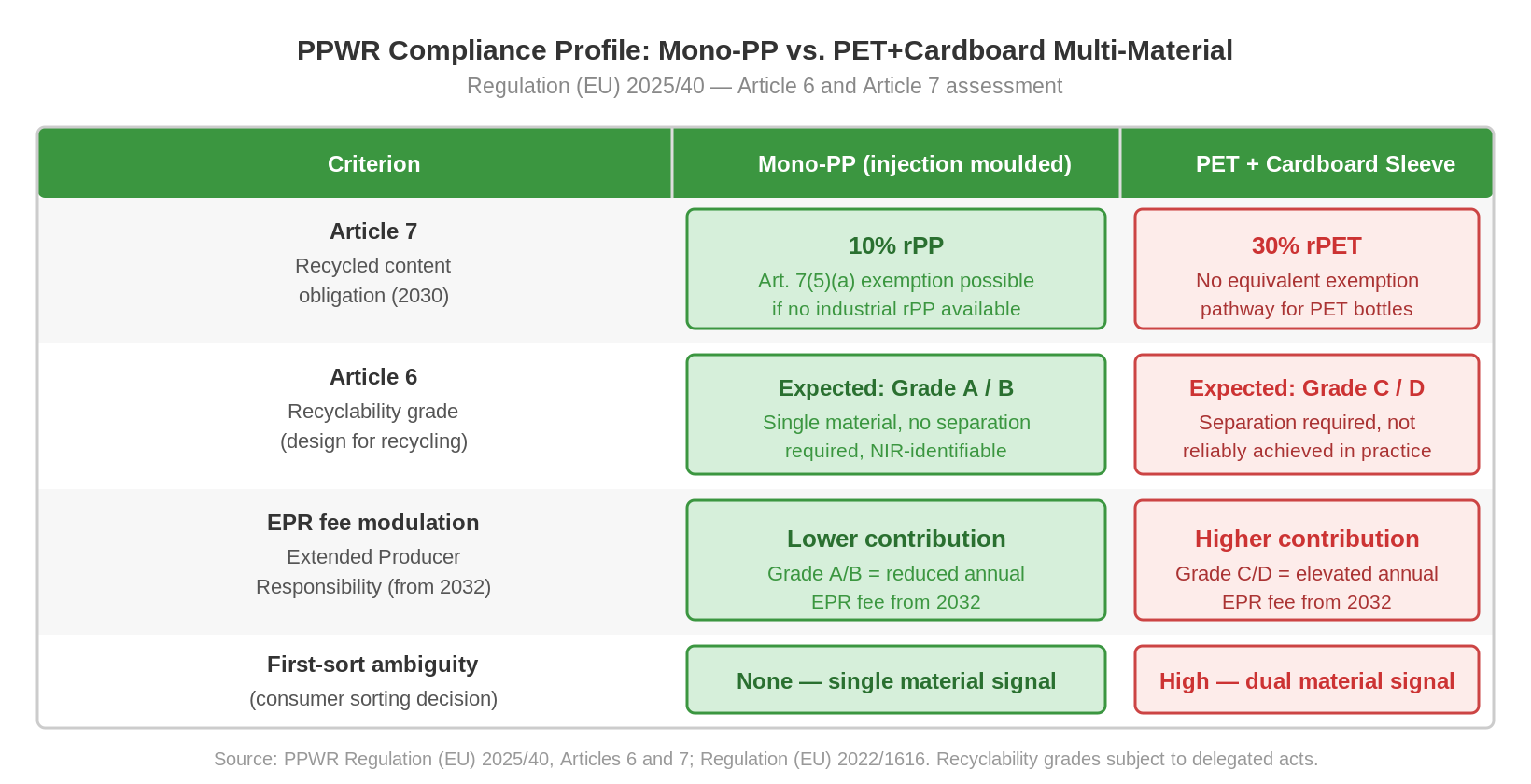
Monomaterial designs—a single type of plastic without secondary material layers—generally score higher on the recyclability scale than multimaterial designs. A monomaterial injection-molded PP cup is designed for direct entry into the PP recycling stream and, in accordance with the regulation’s design principles, will qualify for Grade A or B.

Multi-material solutions—including PET trays or cups with attached cardboard sleeves—are designs that, within the European sorting infrastructure, typically either require manual separation or are sorted together, and thus do not contribute effectively to either PET or paper recycling. This design does not reduce the mandatory requirements for PET content: the PET container is still subject to the 30% rPET requirement regardless of the attached cardboard layer. And under the EPR framework starting in 2032, the multi-material design will most likely score lower and incur higher fees than a comparable single-material solution. Multimaterial packaging and PPWR.


Summary

Under the PPWR, PP and PET are in significantly different regulatory positions leading up to 2030. PET is subject to the 30% requirement for post-consumer recycled content starting in 2030—three times PP’s 10% requirement—and is explicitly excluded from the Article 7(12) derogation mechanism. PP has four documented compliance pathways: mechanical food-grade rPP, chemical rPP via mass balance (subject to the Article 7(8) decision in December 2026), the exemption option under Article 7(5)(a), and the safety valves under Article 7(12) and 7(13). PET currently has, in effect, only one unconditionally approved pathway: mechanical recycling into food-grade rPET—in a market that is contracting and competing internally for limited capacity. Chemical recycling of PET (depolymerization) exists but, like chemical rPP, is awaiting the Article 7(8) decision on mass balance. In addition, monomaterial PP structures score higher on design for recycling under Article 6 than multimaterial solutions, including PET+paper combination structures.

Multi-material packaging and PPWR

Multi-material packaging and PPWR: compliance, sorting, and the "first-sort" problem

Combination solutions that pair plastic packaging with a cardboard sleeve are widespread in the European food market. This design visually conveys the use of paper-based materials and is often marketed as a more sustainable alternative to pure plastic. Under the PPWR, however, the regulatory landscape is more complex than the marketing narrative suggests.

PPWR evaluates packaging along two distinct axes: what it is made of (Article 7, recycled content), and how well it is designed to be part of a recycling loop (Article 6, design for recycling). On both axes, multi-material designs perform worse than single-material designs. And there is a third factor—not regulatory, but practical: the consumer’s decision about which trash bin the packaging ends up in determines whether any recycling can take place at all.

This article reviews all three dimensions. The basic requirements for recycled content are addressed in Recycled Content in Plastic Packaging under PPWR—Requirements, Timeline, and Material Differences. The supply challenge for PET is described in “The rPET Market in Europe.”


Article 6 and recyclability grades: PPWR’s requirements for packaging design

Article 6 of the PPWR stipulates that all packaging placed on the EU market from 2030 must meet specific design requirements for recycling. The Commission classifies packaging into recyclability grades from A to D based on four criteria: material composition, compatibility with existing sorting infrastructure in Europe, availability of recycling capacity, and evidence of actual recycling within the European system.

Grade A refers to packaging that is optimal for recycling: made of a single material, compatible with existing sorting systems, and supported by a proven recycling infrastructure. Grade D refers to packaging that cannot be recycled using existing technology and infrastructure. Starting in 2032, EPR fees will be tiered based on grade: packaging with a Grade A or B rating will incur lower fees than packaging with a Grade C or D rating. This provides a direct financial incentive to choose designs that are engineered for recycling from the outset.

For rigid plastic packaging, the key parameter is the material composition in relation to the sorting streams found in European waste treatment infrastructure. A container made of a single material is, by definition, compatible with a single-material recycling stream. A container that combines two or more materials requires separation so that both can be recycled effectively.


The Paper+PET Composite Structure: Two Obligations, Not One

A PET cup or tray with an attached cardboard sleeve addresses three regulatory weaknesses simultaneously under the PPWR.

First: The PET container is still subject to the full recycled content requirement under Article 7—30% rPET starting in 2030—regardless of whether it has a cardboard sleeve. The cardboard layer is not part of the PET container’s material balance. Two materials with separate obligations do not constitute a reduced overall requirement—they are two separate requirements.

Second, the recyclability grade of the product under Article 6 will most likely be lower than that of a comparable single-material solution. The cardboard sleeve must be separated from the PET container so that both materials can be recycled effectively. If this does not happen—and in automated household collection, it typically does not—either the PET fraction or the cardboard fraction is lost.

Third, a lower recyclability grade will result in higher EPR fees starting in 2032. This is an ongoing, annual cost that is not reflected in the initial production cost but increases the total cost of compliance for the composite design compared to a single-material solution.


Two Types of Multi-Material Packaging—and What They Have in Common

Multi-material packaging that combines plastic and cardboard comes in two fundamentally different types. The first type requires the consumer to actively separate the materials before disposal: the cardboard sleeve is removed by hand and sorted separately. Reliance on consumer behavior is at its highest.

The second type consists of automatically separating designs, in which the separation is intended to occur mechanically at the industrial recycling facility—typically through water-based or thermal processes that break the bond between plastic and cardboard without any action on the part of the consumer. This is a genuine technical difference that reduces reliance on consumer behavior during the separation stage itself.

But both types share one fundamental weakness: they do not solve the first-sort problem. That problem arises before any sorting infrastructure is even involved.

The "first-choice" problem: the consumer's decision determines everything

The first decision is the one consumers make when they discard packaging: which trash can should it go into? This decision is made at home, at work, or in public spaces—and it is made without any quality control.

For single-material plastic packaging, the decision is relatively simple—the packaging consists of a single type of material and is sorted as plastic. This does not rule out the possibility that consumers might sort it incorrectly, but it minimizes the uncertainty that arises when packaging combines two material categories.

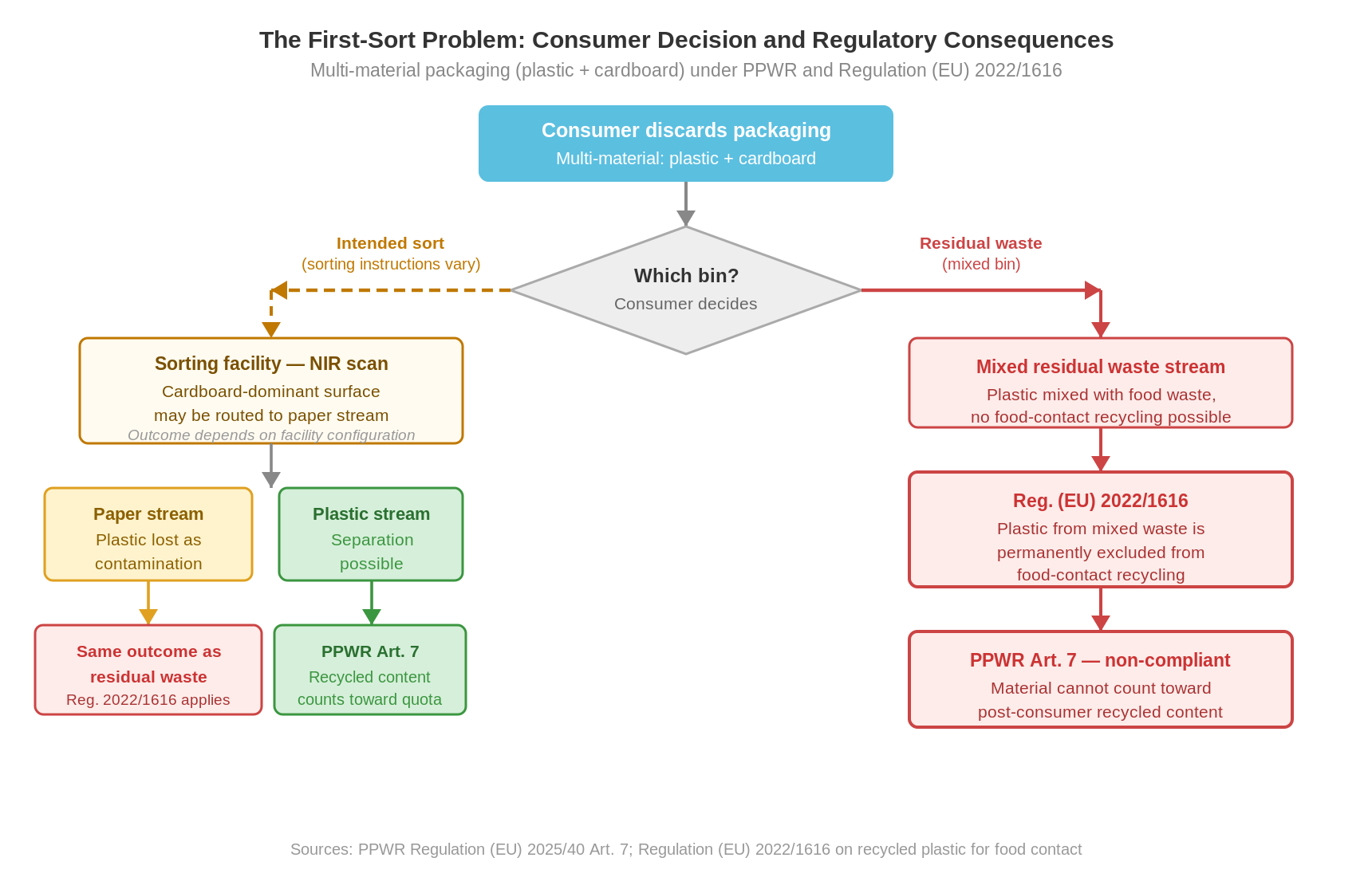
Multi-material packaging adds an extra layer of complexity. Consumers are faced with packaging made of both plastic and cardboard and must interpret local recycling guidelines, which vary from municipality to municipality and from country to country. Some consumers resolve this uncertainty by disposing of the packaging as general waste.

The key argument is not that all consumers will sort their waste incorrectly. The key point is that multi-material packaging introduces an additional decision that does not exist for single-material packaging—and that the entire subsequent recycling chain thus depends on this initial decision being made correctly.

Self-separating technologies address a different issue: Can cardboard and plastic be separated effectively once the packaging has entered the recycling system? This is a relevant technical consideration—but it is a different issue than the “first-sort” problem. “First-sort” deals with something more fundamental: did the packaging even enter the correct system in the first place? Self-separation only creates value if the packaging has first been sorted into the correct waste stream.

This difference is reflected in the number of successive steps that must be successfully completed for the material to actually be recycled. Single-material plastic packaging requires proper consumer sorting, proper optical sorting, and access to approved recycling facilities. A self-separating cardboard/plastic combination also requires a correct initial sorting decision, ensuring the packaging does not end up in residual waste, successful self-separation, correct identification of the plastic fraction after separation, and correct routing to the plastic stream—followed by approved recycling. Each additional dependency reduces the system’s overall robustness.

For automatically separable designs, there is an additional system-related issue: even when the consumer sorts correctly, the packaging must pass through the sorting facility that receives that fraction. Modern sorting facilities use NIR scanning to read the surface of the packaging. A design with a predominantly cardboard surface is typically classified as paper/cardboard and sorted into the paper fraction—which sends the plastic component to the paper bale as contamination, rather than to plastic recycling. Automatic separation only works when the packaging is sorted into a plastic stream equipped with the necessary separation equipment.

For PPWR’s Article 6 assessment, it is crucial that the recyclability rate be based on actual recycling results within the existing European infrastructure—not on what the design is capable of under ideal conditions.


Regulation (EU) 2022/1616: The Long-Term Impact of Residual Waste

Regulation (EU) 2022/1616 on recycled plastics for food contact stipulates that recycled plastics used for food packaging must come from separately collected and sorted plastic fractions. Plastic collected from mixed residual waste is, by definition, excluded from food-contact recycling under this regulation—regardless of the material’s original quality and regardless of the design’s separability characteristics.

The consequence is permanent: plastic that ends up in residual waste can never be used in food packaging again. The same applies to PPWR Article 7’s requirements for post-consumer recycled content: material from the residual waste stream does not meet the definition and cannot contribute to anyone’s compliance with Article 7. Any compliance strategy that relies on recycled content from multi-material products carries the risk that a portion of the virgin material will systematically be excluded from the recyclable stream during the first sorting stage.


Single-material as a reference point

A single-material injection-molded PP container eliminates first-sort ambiguity. The packaging consists of a single material type with no secondary layers—the consumer sees plastic and sorts it into the plastic stream. There is no visual combination of material indicators. NIR scanning unambiguously identifies PP. No separation is required, either by the consumer or at the recycling facility.

Under PPWR, single-material construction—regardless of the polymer—results in fewer dependencies in the recycling chain. For mono-material PP, this specifically means: a lower Article 7 obligation (10% versus PET’s 30%), a higher likelihood of achieving recyclability grades A/B under Article 6, lower EPR fees starting in 2032, and no first-sort ambiguity. A monomaterial PET solution without a cardboard sleeve shares several of these characteristics—the difference lies in the Article 7 level and the supply situation. PP or PET by 2030? The regulatory and supply asymmetry.

Summary

Multi-material designs—including cardboard+PET combination solutions—are at a regulatory disadvantage compared to single-material solutions on both key PPWR axes. Under Article 7, the PET container in a cardboard-and-PET combination design is still subject to the full 30% rPET requirement starting in 2030—the cardboard sleeve does not reduce the material requirements for the plastic component. Under Article 6, multi-material designs receive a lower recyclability rating because effective separation typically does not occur in automated sorting, resulting in higher EPR fees starting in 2032. Added to this is the “first-sort” problem: the consumer determines which waste stream the packaging enters, and plastic that ends up in residual waste is, under Regulation (EU) 2022/1616, permanently excluded from food-contact recycling—regardless of whether the design is automatically separable or not. Self-separation only creates value if the packaging has first been sorted into the correct waste stream. Mono-material PP eliminates all of these issues: lower material requirements, a higher likelihood of achieving recyclability grades A/B, lower EPR fees, and no “first-sort” ambiguity.

Recycled Content in Plastic Packaging Under the PPWR – Requirements, Timeline, and Material Differences

Article 7 of the PPWR—Regulation (EU) 2025/40—sets binding requirements for recycled content in plastic packaging, with two effective dates: 2030 and 2040. The requirements are differentiated: they vary by plastic type and depending on whether the packaging is in direct contact with food, beverages, or pharmaceutical products. For manufacturers selecting packaging materials today, these thresholds constitute the legal framework against which their supply strategy must be assessed.

The key difference in the text of the regulation is the asymmetry between PET and other types of plastic—including PP. PET packaging that comes into contact with food is subject to a threefold higher recycling target by 2030 compared to PP in the same application category: 30% for PET versus 10% for PP. This asymmetry is not accidental. It reflects the fact that PET bottles have had a well-functioning recycling loop in Europe for many years, and that lawmakers have concluded that the market can deliver. A different regulatory assessment applies to PP.

This article describes the specific requirements under Article 7: which thresholds apply to which materials and when, what counts as recycled content, and what exemptions the regulation provides. The question of PP’s four compliance pathways toward 2030 is addressed in “PP or PET Toward 2030? The Regulatory and Supply-Side Asymmetry.”


What counts as recycled content under PPWR?

PPWR uses the term “post-consumer recycled content”—recycled material derived from waste generated by end users: households, businesses, or institutions that have used the product for its intended purpose. This is a crucial distinction.

Pre-consumer material—manufacturing waste and production scrap that is reintroduced into the production process by the same manufacturer, or that has never left the industrial supply chain—does not count. The same applies to regrind (re-ground waste from the manufacturer’s own production floor) and overproduction material that is recycled internally. The PPWR requirement specifically targets material that has actually been in circulation as waste and has been returned to the raw material cycle through sorting and recycling.

For the packaging manufacturer and brand owner, this means that recycled materials must be sourced from verified post-consumer streams: from sorted household waste fractions, collected B2B streams, or the industrial recycling of collected consumer packaging. It is the procurement of this material category that must be documented and compared to the requirement threshold.

Differentiated thresholds—what requirements apply to each type of plastic?

Article 7 differentiates the requirements along two axes: plastic type and contact sensitivity. Contact-sensitive packaging is packaging that comes into direct contact with food, beverages, pharmaceutical products, or cosmetics—a category that, in practice, covers the majority of retail packaging for dairy products, beverages, and convenience foods.

For PET packaging that comes into contact with food, the requirement is 30% post-consumer recycled content starting in 2030, rising to 50% in 2040. This is the highest requirement in the regulation for plastic materials and applies specifically to PET—not to plastics as a category.

For PP and other types of plastic other than PET—including HDPE, PS, and multilayer structures—the requirement is 10% starting in 2030 and 25% starting in 2040 for food-contact packaging. These are weight percentages: 10% of the total plastic mass in the packaging must be verifiably derived from post-consumer recycled material by 2030.

For non-contact-sensitive packaging—transport and industrial packaging that does not come into contact with food—the requirements are less stringent and are set out in separate categories in the annex to the regulation. For many plastic packaging manufacturers that supply the food industry, however, it is the contact-sensitive categories that are relevant. PP or PET by 2030? The regulatory and supply-side asymmetry

Exceptions and Exemptions Under Article 7

The PPWR contains two key exemptions that are relevant to plastic packaging.

Article 7(4)(g) exempts packaging for infant formula, foods for special medical purposes, and other foods intended for vulnerable population groups approved under Regulation (EU) No. 609/2013. The exemption is based on need: for these product categories, food security and the risk of contamination from reused materials are considered sufficiently significant to justify an exemption. However, manufacturers operating in these categories must document the basis for the exemption.

Article 7(5)(a) allows for an exemption from the requirements for materials where there is no industrial recycling capacity on a sufficient scale to supply the necessary post-consumer material of the required quality. For PP packaging, this exemption is potentially relevant: mechanically recycled food-grade PP is a technology under development, and industrial-scale production has not yet been established in most European markets. The exemption requires documentation—the manufacturer must actively demonstrate that the market cannot supply the material and that the relevant recycling technology is not available on an industrial scale.

Article 7(12) is a systemic safety valve: it allows the Commission to postpone the effective date for specific materials if a market review in 2028 shows that the supply chain cannot provide sufficient recycled material. The provision covers PP and other non-PET plastic types. PET is explicitly exempted—Recital 50 states that this is a deliberate choice on the part of the legislator.

Chemical recycling and mass balance—the crucial unknown variable

PPWR’s requirements for post-consumer recycled content raise a key question for PP packaging: Can chemically recycled PP—produced via pyrolysis or solution processes using mass balance allocation—count toward meeting the 2030 requirement?

The answer has not yet been provided. Article 7(8) requires the Commission to adopt an implementing act specifying the methods for calculating and verifying recycled content, including the applicability of the mass balance approach for chemical recycling. This implementing act is expected in December 2026.

Mass balance is a verification method that allows recycled raw materials—such as pyrolysis oil from plastic waste—to be mixed with fossil-based raw materials in a common production stream, and for the recycled content to be allocated to specific product batches via a certification system. The method is well-established in the chemical industry and is currently used for chemically recycled PP from several European manufacturers. It has not yet been determined whether PPWR recognizes this method as documentation for post-consumer recycled content under Article 7.

For PP manufacturers and packaging buyers, this is the most important unresolved variable leading up to 2030. If mass balance is approved, it will open up an additional compliance pathway via chemically recycled PP. If it is not approved, the compliance strategy will rely on mechanically recycled food-grade rPP—a technology not yet available on an industrial scale—or on the exemptions under Article 7(5)(a) and 7(12).

Documentation and Verification of Reused Content

The PPWR requires that the “economic operator” placing the packaging on the market be able to document and verify that the requirements for recycled content have been met. The documentation framework is specified in more detail in implementing acts, but the fundamental requirements are set forth in the text of the regulation.

For mechanically recycled materials, documentation typically takes the form of material certificates from the recycling facility, which specify the material’s origin, recycling method, and post-consumer content. For food contact applications, this is supplemented by the relevant approval documentation—for new and innovative recycling applications, through the national regulatory frameworks.

For chemically recycled material assessed via mass balance, the documentation framework depends on the yet-to-be-published Article 7(8) implementing act. The expected basis is a certification scheme—possibly ISCC+ or equivalent—that can verify that the recycled raw material content actually originates from post-consumer plastic waste.

For packaging manufacturers, this means that the sourcing of recycled materials to ensure compliance with the 2030 targets should be planned with a view to ensuring that the supplier can provide the necessary documentation: not only the material itself, but also the traceability and certification that enable the brand owner to fulfill its documentation obligations to the regulatory authorities.


Summary

Article 7 of Regulation (EU) 2025/40 sets out differentiated requirements for post-consumer recycled content in plastic packaging, to take effect in 2030 and 2040. For PET packaging that comes into contact with food, the requirement is 30% starting in 2030 and 50% starting in 2040—the highest in the regulation for plastic materials. For PP and other non-PET plastic types, the requirement is 10% starting in 2030 and 25% starting in 2040. Recycled content is defined as post-consumer material: pre-consumer manufacturing waste and internal regrind do not count. Key exemptions include Article 7(4)(g) for infant formula and specialized medical products, Article 7(5)(a) for materials without industrial recycling capacity, and Article 7(12), which allows the Commission to defer the requirements for PP—but not PET—following a market review in 2028. Whether chemically recycled PP using the mass balance method qualifies as post-consumer content will be determined in an implementing act under Article 7(8), expected in December 2026.