Article 7 of the PPWR—Regulation (EU) 2025/40—sets binding requirements for recycled content in plastic packaging, with two effective dates: 2030 and 2040. The requirements are differentiated: they vary by plastic type and depending on whether the packaging is in direct contact with food, beverages, or pharmaceutical products. For manufacturers selecting packaging materials today, these thresholds constitute the legal framework against which their supply strategy must be assessed.
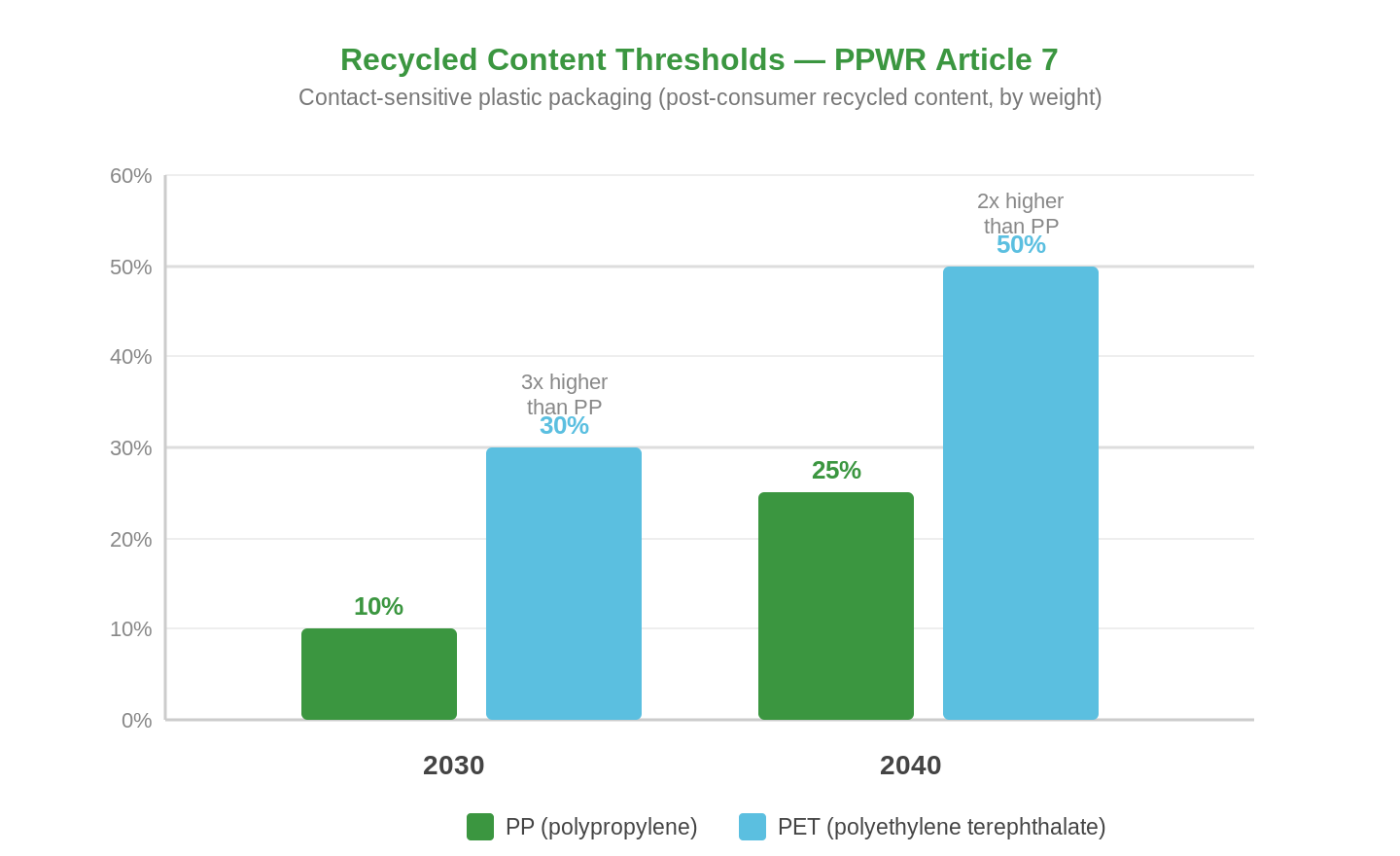
The key difference in the text of the regulation is the asymmetry between PET and other types of plastic—including PP. PET packaging that comes into contact with food is subject to a threefold higher recycling target by 2030 compared to PP in the same application category: 30% for PET versus 10% for PP. This asymmetry is not accidental. It reflects the fact that PET bottles have had a well-functioning recycling loop in Europe for many years, and that lawmakers have concluded that the market can deliver. A different regulatory assessment applies to PP.
This article describes the specific requirements under Article 7: which thresholds apply to which materials and when, what counts as recycled content, and what exemptions the regulation provides. The question of PP’s four compliance pathways toward 2030 is addressed in “PP or PET Toward 2030? The Regulatory and Supply-Side Asymmetry.”
What counts as recycled content under PPWR?
PPWR uses the term “post-consumer recycled content”—recycled material derived from waste generated by end users: households, businesses, or institutions that have used the product for its intended purpose. This is a crucial distinction.
Pre-consumer material—manufacturing waste and production scrap that is reintroduced into the production process by the same manufacturer, or that has never left the industrial supply chain—does not count. The same applies to regrind (re-ground waste from the manufacturer’s own production floor) and overproduction material that is recycled internally. The PPWR requirement specifically targets material that has actually been in circulation as waste and has been returned to the raw material cycle through sorting and recycling.
For the packaging manufacturer and brand owner, this means that recycled materials must be sourced from verified post-consumer streams: from sorted household waste fractions, collected B2B streams, or the industrial recycling of collected consumer packaging. It is the procurement of this material category that must be documented and compared to the requirement threshold.
Differentiated thresholds—what requirements apply to each type of plastic?
Article 7 differentiates the requirements along two axes: plastic type and contact sensitivity. Contact-sensitive packaging is packaging that comes into direct contact with food, beverages, pharmaceutical products, or cosmetics—a category that, in practice, covers the majority of retail packaging for dairy products, beverages, and convenience foods.
For PET packaging that comes into contact with food, the requirement is 30% post-consumer recycled content starting in 2030, rising to 50% in 2040. This is the highest requirement in the regulation for plastic materials and applies specifically to PET—not to plastics as a category.
For PP and other types of plastic other than PET—including HDPE, PS, and multilayer structures—the requirement is 10% starting in 2030 and 25% starting in 2040 for food-contact packaging. These are weight percentages: 10% of the total plastic mass in the packaging must be verifiably derived from post-consumer recycled material by 2030.
For non-contact-sensitive packaging—transport and industrial packaging that does not come into contact with food—the requirements are less stringent and are set out in separate categories in the annex to the regulation. For many plastic packaging manufacturers that supply the food industry, however, it is the contact-sensitive categories that are relevant. PP or PET by 2030? The regulatory and supply-side asymmetry
Exceptions and Exemptions Under Article 7
The PPWR contains two key exemptions that are relevant to plastic packaging.
Article 7(4)(g) exempts packaging for infant formula, foods for special medical purposes, and other foods intended for vulnerable population groups approved under Regulation (EU) No. 609/2013. The exemption is based on need: for these product categories, food security and the risk of contamination from reused materials are considered sufficiently significant to justify an exemption. However, manufacturers operating in these categories must document the basis for the exemption.
Article 7(5)(a) allows for an exemption from the requirements for materials where there is no industrial recycling capacity on a sufficient scale to supply the necessary post-consumer material of the required quality. For PP packaging, this exemption is potentially relevant: mechanically recycled food-grade PP is a technology under development, and industrial-scale production has not yet been established in most European markets. The exemption requires documentation—the manufacturer must actively demonstrate that the market cannot supply the material and that the relevant recycling technology is not available on an industrial scale.
Article 7(12) is a systemic safety valve: it allows the Commission to postpone the effective date for specific materials if a market review in 2028 shows that the supply chain cannot provide sufficient recycled material. The provision covers PP and other non-PET plastic types. PET is explicitly exempted—Recital 50 states that this is a deliberate choice on the part of the legislator.
Chemical recycling and mass balance—the crucial unknown variable
PPWR’s requirements for post-consumer recycled content raise a key question for PP packaging: Can chemically recycled PP—produced via pyrolysis or solution processes using mass balance allocation—count toward meeting the 2030 requirement?
The answer has not yet been provided. Article 7(8) requires the Commission to adopt an implementing act specifying the methods for calculating and verifying recycled content, including the applicability of the mass balance approach for chemical recycling. This implementing act is expected in December 2026.
Mass balance is a verification method that allows recycled raw materials—such as pyrolysis oil from plastic waste—to be mixed with fossil-based raw materials in a common production stream, and for the recycled content to be allocated to specific product batches via a certification system. The method is well-established in the chemical industry and is currently used for chemically recycled PP from several European manufacturers. It has not yet been determined whether PPWR recognizes this method as documentation for post-consumer recycled content under Article 7.
For PP manufacturers and packaging buyers, this is the most important unresolved variable leading up to 2030. If mass balance is approved, it will open up an additional compliance pathway via chemically recycled PP. If it is not approved, the compliance strategy will rely on mechanically recycled food-grade rPP—a technology not yet available on an industrial scale—or on the exemptions under Article 7(5)(a) and 7(12).
Documentation and Verification of Reused Content
The PPWR requires that the “economic operator” placing the packaging on the market be able to document and verify that the requirements for recycled content have been met. The documentation framework is specified in more detail in implementing acts, but the fundamental requirements are set forth in the text of the regulation.
For mechanically recycled materials, documentation typically takes the form of material certificates from the recycling facility, which specify the material’s origin, recycling method, and post-consumer content. For food contact applications, this is supplemented by the relevant approval documentation—for new and innovative recycling applications, through the national regulatory frameworks.
For chemically recycled material assessed via mass balance, the documentation framework depends on the yet-to-be-published Article 7(8) implementing act. The expected basis is a certification scheme—possibly ISCC+ or equivalent—that can verify that the recycled raw material content actually originates from post-consumer plastic waste.
For packaging manufacturers, this means that the sourcing of recycled materials to ensure compliance with the 2030 targets should be planned with a view to ensuring that the supplier can provide the necessary documentation: not only the material itself, but also the traceability and certification that enable the brand owner to fulfill its documentation obligations to the regulatory authorities.
Summary
Article 7 of Regulation (EU) 2025/40 sets out differentiated requirements for post-consumer recycled content in plastic packaging, to take effect in 2030 and 2040. For PET packaging that comes into contact with food, the requirement is 30% starting in 2030 and 50% starting in 2040—the highest in the regulation for plastic materials. For PP and other non-PET plastic types, the requirement is 10% starting in 2030 and 25% starting in 2040. Recycled content is defined as post-consumer material: pre-consumer manufacturing waste and internal regrind do not count. Key exemptions include Article 7(4)(g) for infant formula and specialized medical products, Article 7(5)(a) for materials without industrial recycling capacity, and Article 7(12), which allows the Commission to defer the requirements for PP—but not PET—following a market review in 2028. Whether chemically recycled PP using the mass balance method qualifies as post-consumer content will be determined in an implementing act under Article 7(8), expected in December 2026.
Frequently Asked Questions
No. Article 7 differentiates the requirements. PET packaging that comes into contact with food is subject to the strictest requirements: 30% by 2030 and 50% by 2040. For PP and other non-PET plastic types in contact-sensitive applications, the requirement is 10% by 2030 and 25% by 2040. The requirements are based on what the market for recycled material of each type can actually supply.
No. PPWR requires post-consumer recycled content—material derived from waste generated by end users after use. Pre-consumer material, such as manufacturing waste, regrind from the production floor, and industrial surplus material that has not left the industrial supply chain, does not count.
Not directly. Article 7(4)(g) exempts packaging for infant formula, foods for special medical purposes, and products covered by Regulation (EU) No. 609/2013. The exemption requires documentation and is justified on the grounds of security of supply and contamination concerns for vulnerable consumer groups.
This will be determined in an implementing act under Article 7(8), which is expected to be published in December 2026. Until then, it remains unclear whether chemically recycled PP, as determined using the mass balance method, counts as post-consumer recycled content under the PPWR.
The regulation contains two relevant mechanisms. Article 7(5)(a) allows for an exemption if there is no industrial recycling capacity for the material on a sufficient scale. Article 7(12) allows the Commission to postpone the entry into force for PP following a market review in 2028. PET has no corresponding safety valves.


