Multi-material packaging and PPWR: compliance, sorting, and the "first-sort" problem
Combination solutions that pair plastic packaging with a cardboard sleeve are widespread in the European food market. This design visually conveys the use of paper-based materials and is often marketed as a more sustainable alternative to pure plastic. Under the PPWR, however, the regulatory landscape is more complex than the marketing narrative suggests.
PPWR evaluates packaging along two distinct axes: what it is made of (Article 7, recycled content), and how well it is designed to be part of a recycling loop (Article 6, design for recycling). On both axes, multi-material designs perform worse than single-material designs. And there is a third factor—not regulatory, but practical: the consumer’s decision about which trash bin the packaging ends up in determines whether any recycling can take place at all.
This article reviews all three dimensions. The basic requirements for recycled content are addressed in Recycled Content in Plastic Packaging under PPWR—Requirements, Timeline, and Material Differences. The supply challenge for PET is described in “The rPET Market in Europe.”
Article 6 and recyclability grades: PPWR’s requirements for packaging design
Article 6 of the PPWR stipulates that all packaging placed on the EU market from 2030 must meet specific design requirements for recycling. The Commission classifies packaging into recyclability grades from A to D based on four criteria: material composition, compatibility with existing sorting infrastructure in Europe, availability of recycling capacity, and evidence of actual recycling within the European system.
Grade A refers to packaging that is optimal for recycling: made of a single material, compatible with existing sorting systems, and supported by a proven recycling infrastructure. Grade D refers to packaging that cannot be recycled using existing technology and infrastructure. Starting in 2032, EPR fees will be tiered based on grade: packaging with a Grade A or B rating will incur lower fees than packaging with a Grade C or D rating. This provides a direct financial incentive to choose designs that are engineered for recycling from the outset.
For rigid plastic packaging, the key parameter is the material composition in relation to the sorting streams found in European waste treatment infrastructure. A container made of a single material is, by definition, compatible with a single-material recycling stream. A container that combines two or more materials requires separation so that both can be recycled effectively.
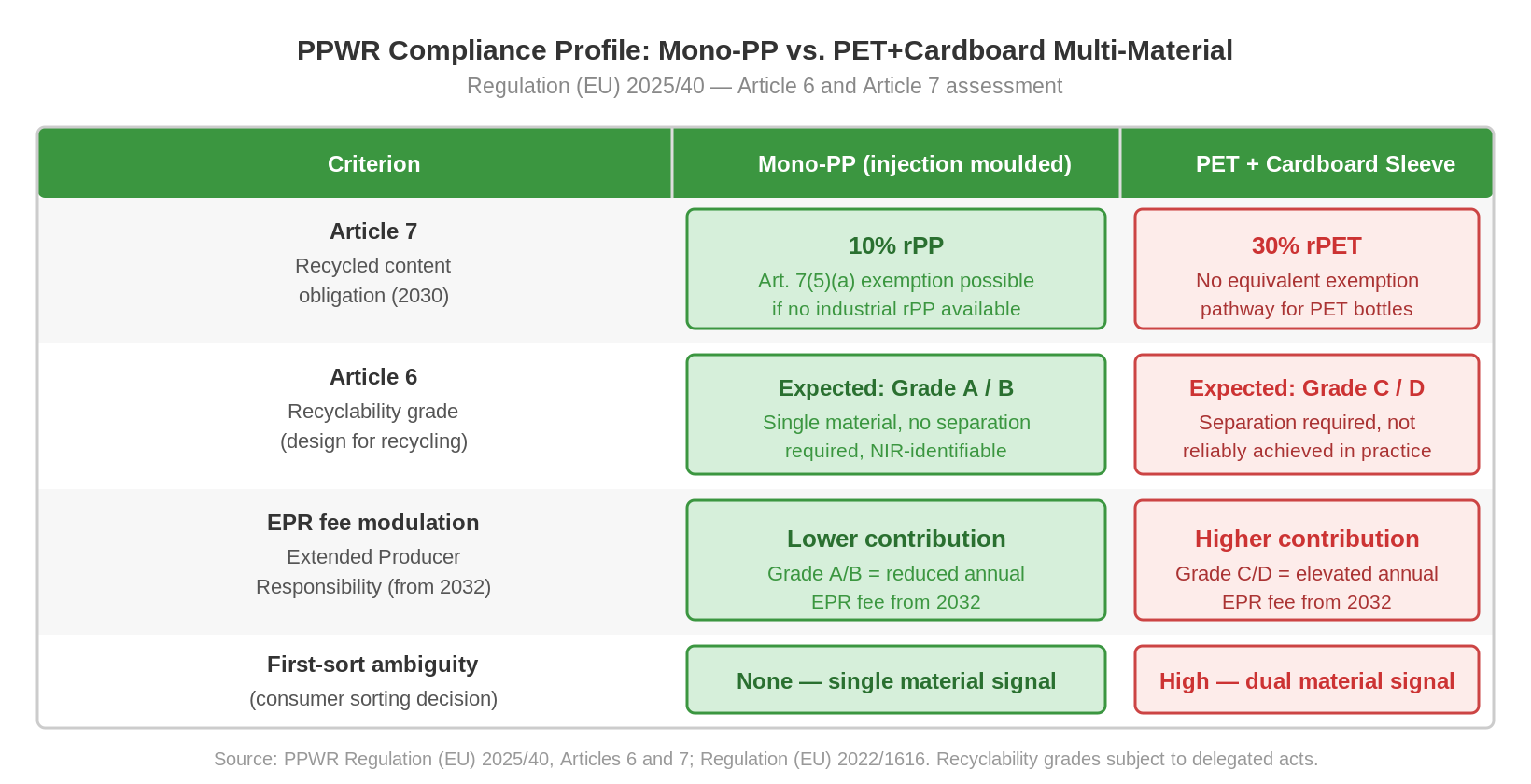
The Paper+PET Composite Structure: Two Obligations, Not One
A PET cup or tray with an attached cardboard sleeve addresses three regulatory weaknesses simultaneously under the PPWR.
First: The PET container is still subject to the full recycled content requirement under Article 7—30% rPET starting in 2030—regardless of whether it has a cardboard sleeve. The cardboard layer is not part of the PET container’s material balance. Two materials with separate obligations do not constitute a reduced overall requirement—they are two separate requirements.
Second, the recyclability grade of the product under Article 6 will most likely be lower than that of a comparable single-material solution. The cardboard sleeve must be separated from the PET container so that both materials can be recycled effectively. If this does not happen—and in automated household collection, it typically does not—either the PET fraction or the cardboard fraction is lost.
Third, a lower recyclability grade will result in higher EPR fees starting in 2032. This is an ongoing, annual cost that is not reflected in the initial production cost but increases the total cost of compliance for the composite design compared to a single-material solution.
Two Types of Multi-Material Packaging—and What They Have in Common
Multi-material packaging that combines plastic and cardboard comes in two fundamentally different types. The first type requires the consumer to actively separate the materials before disposal: the cardboard sleeve is removed by hand and sorted separately. Reliance on consumer behavior is at its highest.
The second type consists of automatically separating designs, in which the separation is intended to occur mechanically at the industrial recycling facility—typically through water-based or thermal processes that break the bond between plastic and cardboard without any action on the part of the consumer. This is a genuine technical difference that reduces reliance on consumer behavior during the separation stage itself.
But both types share one fundamental weakness: they do not solve the first-sort problem. That problem arises before any sorting infrastructure is even involved.
The "first-choice" problem: the consumer's decision determines everything
The first decision is the one consumers make when they discard packaging: which trash can should it go into? This decision is made at home, at work, or in public spaces—and it is made without any quality control.
For single-material plastic packaging, the decision is relatively simple—the packaging consists of a single type of material and is sorted as plastic. This does not rule out the possibility that consumers might sort it incorrectly, but it minimizes the uncertainty that arises when packaging combines two material categories.
Multi-material packaging adds an extra layer of complexity. Consumers are faced with packaging made of both plastic and cardboard and must interpret local recycling guidelines, which vary from municipality to municipality and from country to country. Some consumers resolve this uncertainty by disposing of the packaging as general waste.
The key argument is not that all consumers will sort their waste incorrectly. The key point is that multi-material packaging introduces an additional decision that does not exist for single-material packaging—and that the entire subsequent recycling chain thus depends on this initial decision being made correctly.
Self-separating technologies address a different issue: Can cardboard and plastic be separated effectively once the packaging has entered the recycling system? This is a relevant technical consideration—but it is a different issue than the “first-sort” problem. “First-sort” deals with something more fundamental: did the packaging even enter the correct system in the first place? Self-separation only creates value if the packaging has first been sorted into the correct waste stream.
This difference is reflected in the number of successive steps that must be successfully completed for the material to actually be recycled. Single-material plastic packaging requires proper consumer sorting, proper optical sorting, and access to approved recycling facilities. A self-separating cardboard/plastic combination also requires a correct initial sorting decision, ensuring the packaging does not end up in residual waste, successful self-separation, correct identification of the plastic fraction after separation, and correct routing to the plastic stream—followed by approved recycling. Each additional dependency reduces the system’s overall robustness.
For automatically separable designs, there is an additional system-related issue: even when the consumer sorts correctly, the packaging must pass through the sorting facility that receives that fraction. Modern sorting facilities use NIR scanning to read the surface of the packaging. A design with a predominantly cardboard surface is typically classified as paper/cardboard and sorted into the paper fraction—which sends the plastic component to the paper bale as contamination, rather than to plastic recycling. Automatic separation only works when the packaging is sorted into a plastic stream equipped with the necessary separation equipment.
For PPWR’s Article 6 assessment, it is crucial that the recyclability rate be based on actual recycling results within the existing European infrastructure—not on what the design is capable of under ideal conditions.
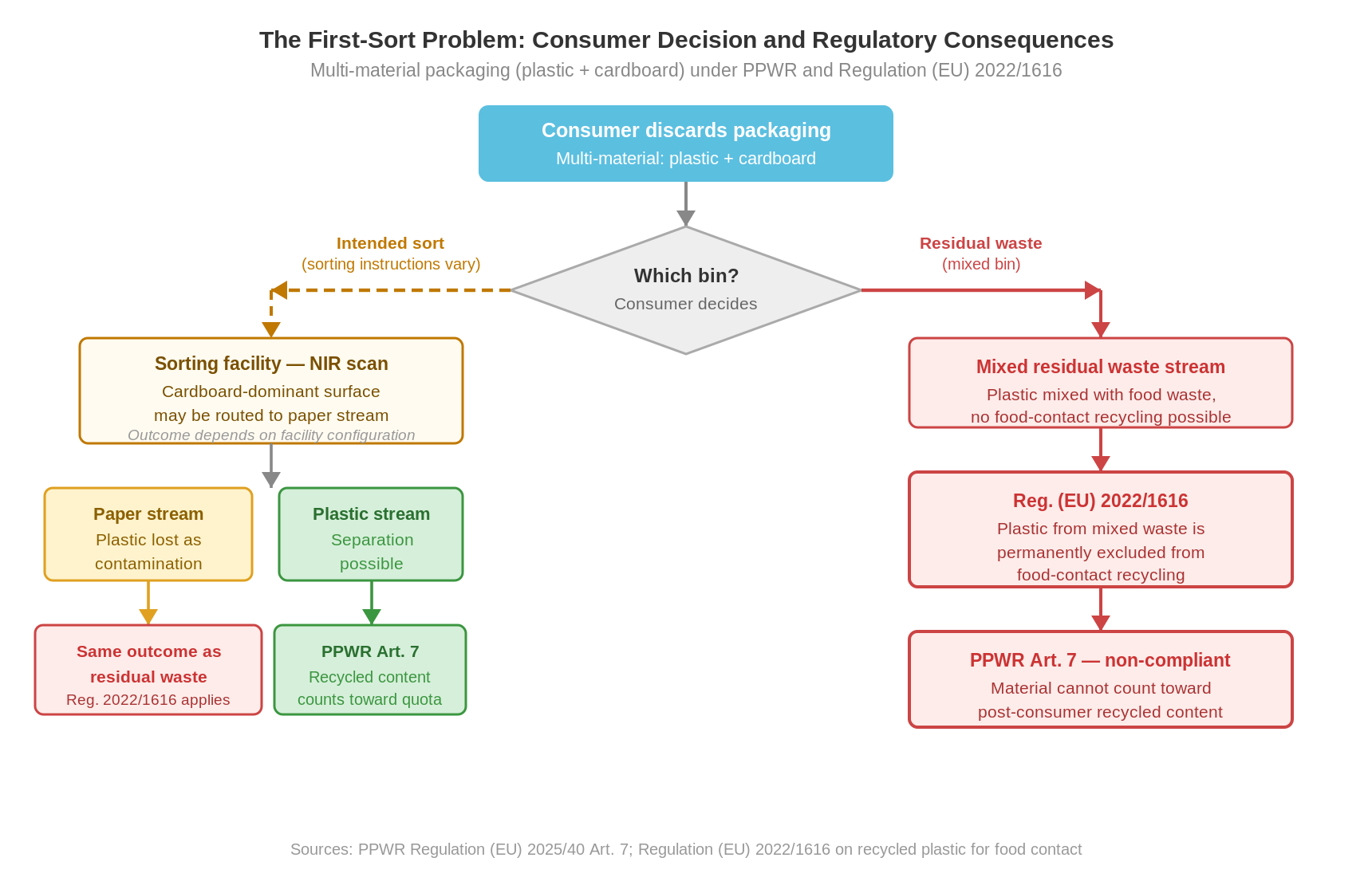
Regulation (EU) 2022/1616: The Long-Term Impact of Residual Waste
Regulation (EU) 2022/1616 on recycled plastics for food contact stipulates that recycled plastics used for food packaging must come from separately collected and sorted plastic fractions. Plastic collected from mixed residual waste is, by definition, excluded from food-contact recycling under this regulation—regardless of the material’s original quality and regardless of the design’s separability characteristics.
The consequence is permanent: plastic that ends up in residual waste can never be used in food packaging again. The same applies to PPWR Article 7’s requirements for post-consumer recycled content: material from the residual waste stream does not meet the definition and cannot contribute to anyone’s compliance with Article 7. Any compliance strategy that relies on recycled content from multi-material products carries the risk that a portion of the virgin material will systematically be excluded from the recyclable stream during the first sorting stage.
Single-material as a reference point
A single-material injection-molded PP container eliminates first-sort ambiguity. The packaging consists of a single material type with no secondary layers—the consumer sees plastic and sorts it into the plastic stream. There is no visual combination of material indicators. NIR scanning unambiguously identifies PP. No separation is required, either by the consumer or at the recycling facility.
Under PPWR, single-material construction—regardless of the polymer—results in fewer dependencies in the recycling chain. For mono-material PP, this specifically means: a lower Article 7 obligation (10% versus PET’s 30%), a higher likelihood of achieving recyclability grades A/B under Article 6, lower EPR fees starting in 2032, and no first-sort ambiguity. A monomaterial PET solution without a cardboard sleeve shares several of these characteristics—the difference lies in the Article 7 level and the supply situation. PP or PET by 2030? The regulatory and supply asymmetry.
Summary
Multi-material designs—including cardboard+PET combination solutions—are at a regulatory disadvantage compared to single-material solutions on both key PPWR axes. Under Article 7, the PET container in a cardboard-and-PET combination design is still subject to the full 30% rPET requirement starting in 2030—the cardboard sleeve does not reduce the material requirements for the plastic component. Under Article 6, multi-material designs receive a lower recyclability rating because effective separation typically does not occur in automated sorting, resulting in higher EPR fees starting in 2032. Added to this is the “first-sort” problem: the consumer determines which waste stream the packaging enters, and plastic that ends up in residual waste is, under Regulation (EU) 2022/1616, permanently excluded from food-contact recycling—regardless of whether the design is automatically separable or not. Self-separation only creates value if the packaging has first been sorted into the correct waste stream. Mono-material PP eliminates all of these issues: lower material requirements, a higher likelihood of achieving recyclability grades A/B, lower EPR fees, and no “first-sort” ambiguity.
Frequently Asked Questions
No. The PET container in a cardboard+PET structure is still subject to the full 30% rPET requirement under Article 7 starting in 2030. The cardboard sleeve is a separate material with its own material profile and does not affect the amount of post-consumer recycled content that must be verifiably present in the plastic component.
Only partially. Automatically separable designs eliminate the need for active separation by the consumer during the recycling stage—but they do not solve the “first-sort” problem. The consumer still determines which waste stream the packaging enters. Self-separation only creates value if the packaging has first been sorted into the correct waste stream. Under Regulation (EU) 2022/1616, plastic that ends up in residual waste is permanently excluded from food-contact recycling—regardless of the design’s separation properties.
Regulation (EU) 2022/1616 excludes plastic from mixed residual waste from food-contact recycling. The material can never be recycled into food packaging, regardless of its original quality, and it does not count toward the post-consumer recycled content required under PPWR Article 7. This restriction is permanent.
NIR scanners scan the surface of the packaging. A structure with a predominantly cardboard surface is typically classified as paper/cardboard and sorted into the paper fraction—which sends the plastic component to the paper bale as contamination rather than to plastic recycling. The automatic separation feature only works when the packaging is sorted into a plastic stream equipped with the necessary separation equipment.
Although not automatically, single-material PP structures designed with a pure material composition, standardized color, and no attached secondary materials are structurally compatible with the design requirements of Article 6 and will typically qualify for Grade A or B. The final grades will be specified in delegated acts to be published on an ongoing basis leading up to 2030.


