Steel Grades for Injection Molding Tools – Selection of Tool Steel
The choice of steel for an injection molding mold is one of the decisions that has the greatest impact on the mold’s service life, maintenance requirements, and ability to deliver consistent part quality over time.
Nevertheless, in many projects, the choice of steel is treated as a technical detail left to the toolmaker, rather than as a strategic decision that should be made based on a concrete understanding of the production requirements.
This article reviews the most commonly used types of steel for injection molding tools, how they differ, and the factors that should guide the selection for a specific project.
Why the choice of steel is crucial
An injection molding mold is subjected to repeated thermal and mechanical stresses in every single cycle. The plastic material is injected under high pressure, cools and shrinks, and the part is ejected. This process is repeated hundreds of thousands or millions of times over the mold’s service life.
The steel must withstand these loads without deforming, cracking, or wearing to a degree that affects the quality of the workpiece. At the same time, it must be machinable to the required tolerances, polishable to the desired surface finish, and, in many cases, hardenable to increase its wear resistance.
The right steel is the one that best balances these requirements in relation to the specific project’s volume, material, and tolerance requirements. You can read more about how much an injection molding tool might cost here.
The Most Commonly Used Types of Steel
Pre-hardened steel
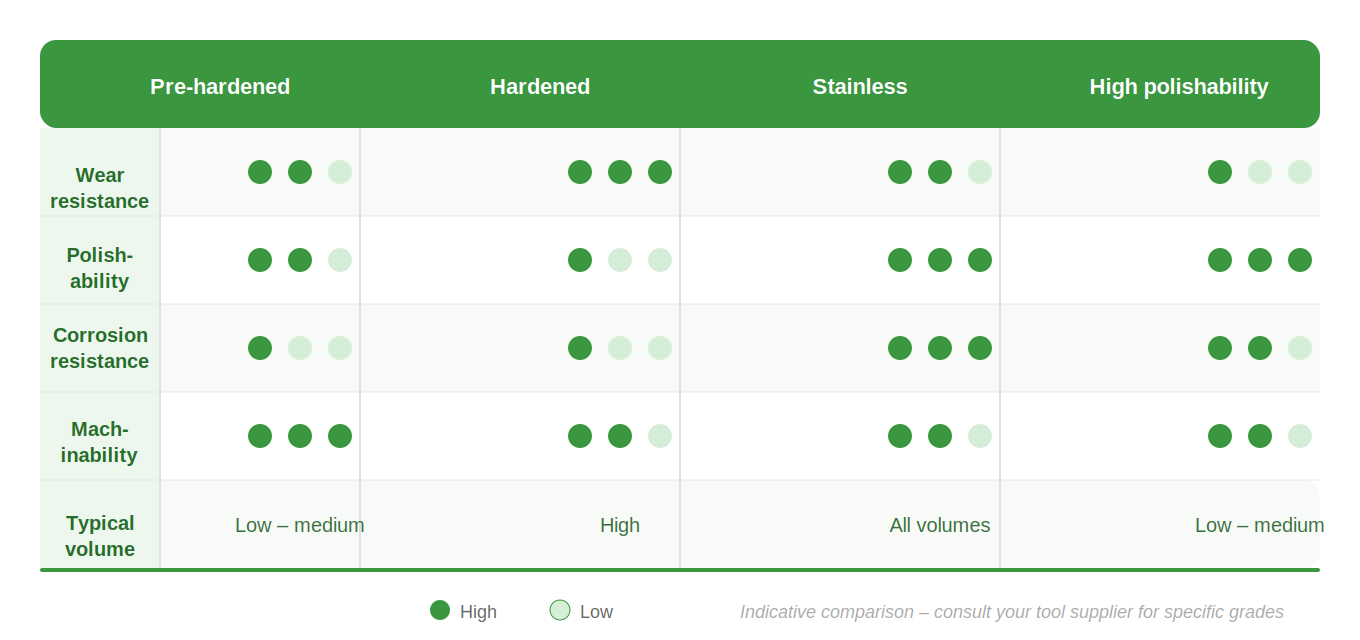
Pre-hardened steel is supplied in a pre-hardened condition and does not require further heat treatment after machining. It is the most commonly used grade for injection molding tools in standard- and medium-volume production.
Steels in this category are well-suited for mold cavities and cores, are easy to machine, and offer good polishability. They are not suitable for highly abrasive materials or extremely high production volumes, but cover a wide range of applications. Typical designations include P20 and 718—or supplier-specific variants such as Impax Supreme and Holdax from Uddeholm, which have comparable properties.
Hardened steel
Hardened steel achieves its final hardness through heat treatment after machining. This provides significantly higher wear resistance and makes it well-suited for high-volume production and for machining abrasive materials such as glass-fiber-reinforced and mineral-filled plastics.
H13 is one of the most commonly used designations in this category and is known by product names such as Orvar Supreme from Uddeholm. It offers good toughness and heat resistance, making it well-suited for demanding production conditions involving high temperatures and long runs. For particularly abrasive materials and extremely high production volumes, powder metallurgical steels such as Vanadis 4 Extra and Unimax are also available, combining high hardness with good toughness.
Stainless steel
Stainless steel is primarily used in situations where corrosion resistance is a requirement. This is particularly true in the production of medical equipment, food packaging, and components made of PVC or other corrosive types of plastic.
Steels in this category, typically designated S136 or sold under product names such as Stavax ESR and Corrax from Uddeholm, combine good polishability with high corrosion resistance and are well-suited for mold cavities with high surface quality requirements. Corrax stands out as a pre-hardened stainless steel that does not require heat treatment, making it easier to machine and repair.
Steel with high polishability
For applications with particularly high requirements for mirror polishing—such as optical components or visible design surfaces—steel with an exceptionally high degree of purity is used. Polmax from Uddeholm is an example of a steel developed specifically for this application, where the purity of the steel melt is critical to the final polishing result.
Copper-alloy inserts
Copper-alloyed materials are not used as structural steel for entire mold halves, but rather as inserts in areas with specific cooling requirements. They have a significantly higher thermal conductivity than steel and can be used to increase cooling efficiency in localized hot spots.
When manufacturing products for the food industry and medical devices, the choice of materials in these zones should always be verified against applicable regulatory requirements, as not all copper alloys are approved for contact with or proximity to food.
The factors that influence the choice
Production Volume
Expected lifetime volume is the most critical single factor. For prototype production and low-volume runs, a softer and less expensive steel may well suffice. For production runs in the millions, hardened steel is essential to avoid premature replacement of mold cavities and cores. You can read more about this in the article: What Determines the Service Life of an Injection Molding Tool?
Plastic material
Abrasive plastics such as glass-fiber-reinforced polyamide or mineral-filled PP wear down steel significantly faster than standard materials. These materials require higher hardness and wear resistance. Corrosive plastics such as PVC and POM require corrosion resistance. The article “From Idea to Finished Injection Mold” discusses this topic, among others.
Surface Requirements
Applications with high requirements for mirror polishing or textured finishes place special demands on steel quality and purity. Not all steel can be polished to optical quality—the purity of the steel melt is crucial here, and high-purity specialty steels are typically required.
Tolerance Requirements and Dimensional Stability Tight tolerances require steel with good dimensional stability during heat treatment. Certain types of steel deform more than others during hardening, which may require post-processing.
Refrigeration Requirements
In cases where standard cooling is insufficient and conformal cooling channels or local cooling inserts are required, the choice of material in those specific zones may differ from the rest of the mold.
Steel Selection and Maintenance
The choice of steel directly affects how easy and expensive it is to maintain a tool over time. Hardened steel is more wear-resistant, but more difficult and expensive to repair, as welding and finishing require more specialized work. Pre-hardened steel is easier to machine and repair, but wears out faster under demanding production conditions.
The choice is therefore not just a matter of initial service life, but of the overall maintenance strategy for the tool.
Summary
The choice of steel for an injection molding tool should be based on production volume, plastic material, surface finish requirements, and tolerance requirements. There is no one-size-fits-all solution—the right steel is the one that best matches the project’s specific requirements and the planned maintenance strategy.
Choosing the right steel from the start reduces the risk of premature wear, minimizes maintenance needs, and ensures that the investment in the tool delivers the expected return over its service life.
Frequently Asked Questions
Pre-hardened steels such as P20 and 718 are the most commonly used for standard and medium-volume production. For high-volume production and abrasive materials, hardened steels such as H13 are used.
Stainless steel is used in the production of medical devices, food packaging, and components made from corrosive plastics such as PVC. It is also used in applications with high requirements for polishability and surface quality.
Yes. High-alloy and hardened steels are more expensive to purchase and more time-consuming to machine. The higher initial investment is typically offset by a significantly longer service life and lower maintenance costs.
Yes, but it is more challenging than repairing pre-hardened steel. Welding on hardened steel requires specialized equipment and subsequent heat treatment to restore the steel's structure.
The key factor is whether the material is approved for contact with or proximity to food in accordance with applicable regulatory requirements. Stainless steel with high corrosion resistance is typically the safe choice, while other materials, including certain copper-alloyed inserts, should always be verified before use in a food context.


