The rPET Market in Europe: Supply, Capacity, and Competition for Food-Grade Material
PET is often highlighted as an ideal packaging material in the transition to a more circular economy. The material has a well-established recycling infrastructure, and food-grade recycled PET (rPET) is already commercially available in Europe.
But as the EU’s Packaging Regulation (PPWR) sets new requirements for recycled content leading up to 2030, a key question arises: Can the existing European rPET industry ensure sufficient quantities of food-grade material for all the types of packaging that will be required to use it in the future?
This issue is particularly relevant for manufacturers of food trays, cups, and bowls. In this sector, supply conditions differ from those in the bottle market, which has historically been the driving force behind the development of PET recycling.
For companies currently considering switching from polypropylene (PP) to PET, it is therefore important to look beyond the materials’ current properties and assess the long-term regulatory and supply-chain implications.
PP and PET are not subject to the same requirements. While PP must, as a general rule, contain 10% recycled plastic starting in 2030, the requirement for food-contact PET packaging is 30%. At the same time, the PPWR provides for specific exemptions and waivers that may be relevant to PP-based food packaging.
PET’s existing recycling infrastructure does not necessarily mean that PET is the most advantageous packaging choice leading up to 2030.
See also: PP or PET by 2030? The regulatory and supply asymmetry.
The European rPET market is centered on bottles
The European PET recycling industry has primarily developed to collect and recycle beverage bottles.
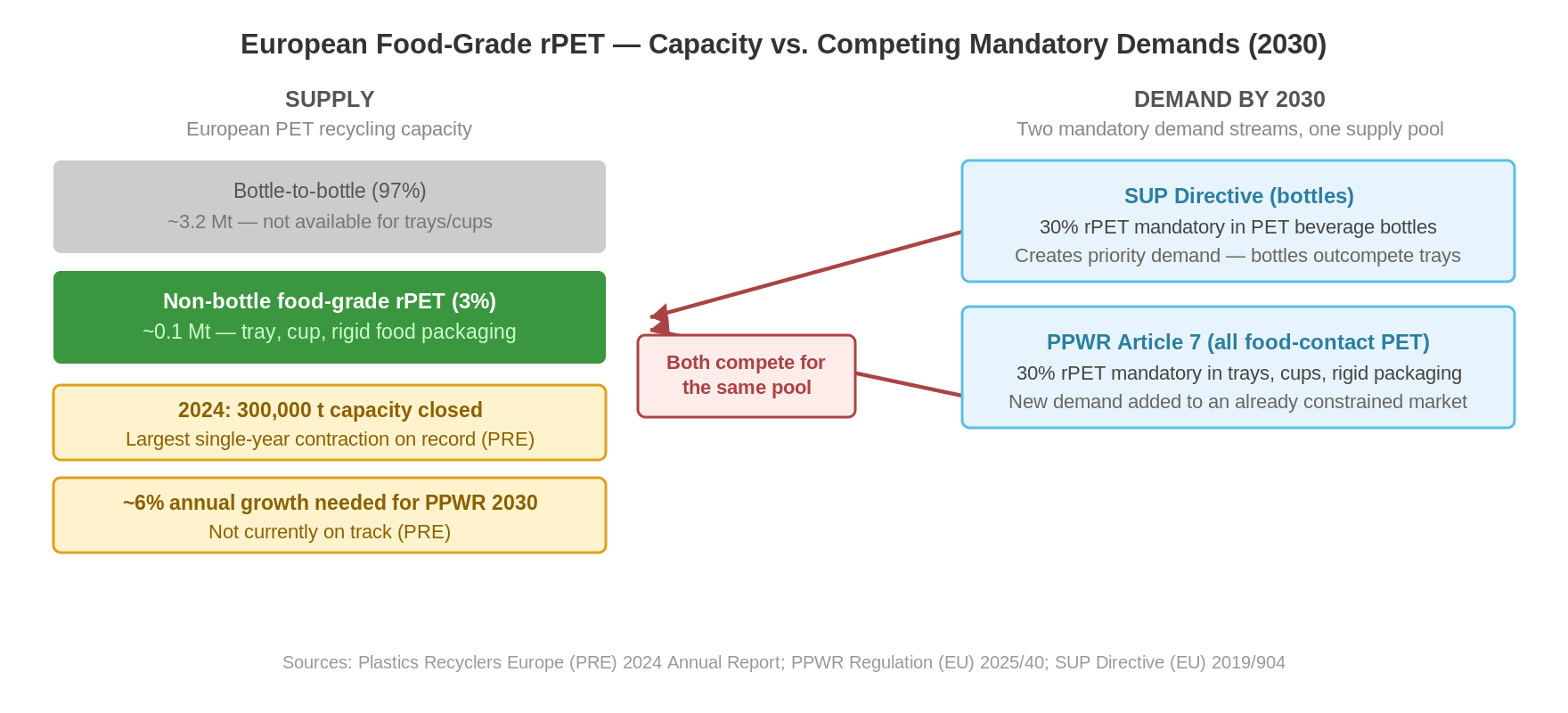
According to Plastics Recyclers Europe (PRE), Europe had a total installed PET recycling capacity of approximately 3.3 million metric tons in 2024.
Of this, approximately 100,000 metric tons were dedicated to the recycling of PET trays, which corresponds to only about 3% of the total capacity.
This illustrates a significant structural difference between the types of packaging.
Although food-grade rPET from bottle recycling can also be used to manufacture other types of food packaging, the dedicated infrastructure for the collection, sorting, and recycling of PET trays remains significantly less developed.
Industrial solutions for bin-to-bin recycling already exist, but their total capacity is limited compared to traditional bottle-to-bottle recycling.
For manufacturers of PET trays, cups, and bowls, this means that their access to recycled material may depend to a significant extent on the same material stream used by the beverage industry.
And this is where a key challenge lies.
The fact that there is 3.3 million metric tons of PET recycling capacity in Europe does not mean that this capacity can be freely used for all types of PET packaging.
The material must have the necessary properties, be certified as suitable for food contact, and be available in the required quantities.
It is therefore important to distinguish between the total recycling capacity and the actual availability of material for a specific packaging application.
A recycling industry under economic pressure
While the EU is tightening its requirements for recycled content, the European plastics recycling industry is facing significant economic challenges.
PRE’s report, *Plastics Recycling Industry Figures 2024*, published in 2025, documents a 5.5% decline in revenue in the European plastics recycling industry in 2024.
During the same period, recycling facilities with a total capacity of approximately 300,000 metric tons were shut down. This figure covers the entire plastics recycling industry and is not limited to PET.
The industry association cites, among other things, high production and energy costs, declining demand, and competition from cheaper imported recycled plastic.
The PET market has not been left unaffected by these developments.
Although installed PET recycling capacity rose from 3.2 to 3.3 million metric tons in 2024, recycling companies reported rising inventories of rPET pellets due to competition from cheaper imported materials.
This shows that the market is facing a challenge that is not just about capacity.
In the short term, there may be sufficient material available, even as European recycling companies struggle to maintain profitable production.
In the long term, this could have consequences for investments in new capacity and, consequently, for the ability to supply the volumes of recycled plastic for which PPWR is expected to create demand.
PRE estimates that the European plastics recycling industry as a whole needs an annual capacity growth of about 6% to support the upcoming PPWR targets. According to the organization, current trends are below this level.
It does not prove that there will definitely be a shortage of food-grade rPET in 2030.
However, this shows that PET’s future security of supply should not be taken for granted.
Two EU regulations are increasing demand for recycled PET
The supply challenge becomes particularly relevant when considering the interaction between the EU’s Single-Use Plastics Directive (SUP Directive) and the Packaging and Packaging Waste Regulation (PPWR).
The SUP Directive requires that PET beverage bottles contain 25% recycled plastic starting in 2025 and that covered single-use beverage bottles contain 30% recycled plastic starting in 2030.
At the same time, PPWR is introducing a requirement for 30% recycled content in contact-sensitive PET packaging, including many types of food trays, cups, and bowls.
The requirements for beverage bottles overlap and should not be combined. However, the regulation means that several packaging segments will be subject to a legal obligation to use recycled plastic.
For PET-based food packaging, this could create a situation in which multiple industries compete for suitable material grades from the same recycling system.
The beverage industry already has established supply chains, standardized material requirements, and significant purchasing volumes.
Manufacturers of PET trays and cups, on the other hand, must ensure that the material they use not only meets food contact requirements but also has the technical properties necessary for their specific packaging.
For example, this may include requirements for formability, mechanical strength, transparency, and process stability.
The various packaging industries will therefore not necessarily compete on a level playing field.
This does not mean that PET trays and cups cannot be manufactured from recycled material. However, their manufacturers may become more dependent on price trends, material quality, and availability in a recycling industry that is primarily geared toward the bottle segment.
For companies that choose PET for food packaging, securing the right quality of rPET therefore becomes part of their long-term supply strategy—not just a routine raw material purchase.
Security of supply and economics: Two factors to consider before switching materials
When a food manufacturer is considering changing packaging materials, it is natural to focus on factors such as the packaging’s function, design, weight, and purchase price.
However, with PPWR, it will also be necessary to assess what requirements the selected material will be subject to in the coming years.
For PET-based food packaging, this means, among other things, that manufacturers must, as a general rule, be able to document 30% recycled content starting in 2030, subject to the relevant implementation dates and exceptions.
A company should therefore determine whether its packaging supplier can guarantee the necessary quantities of food-grade rPET and what impact this will have on the future price of the material.
It is also important to assess whether the supplier has alternative sources of supply and how requirements regarding traceability, documentation, and food contact are handled.
A technically feasible packaging solution is not necessarily the same as an economically attractive solution in the long term.
A change in packaging should therefore not be evaluated solely based on current conditions, but also on the regulatory requirements and the supply risks the company will face leading up to 2030 and 2040.
And this is precisely where PP has some significant advantages that should be included in the comparison.
PP: A strong alternative with a different regulatory profile
While PET currently has a well-established recycling infrastructure but at the same time faces relatively high requirements for recycled content, the situation is different for PP.
PPWR makes a clear distinction between PET and other types of plastic, including PP, when setting requirements for recycled content.
For food packaging that comes into contact with food, the basic principle is:
| Materials | 2030 | 2040 |
| PET | 30 % | 50 % |
| PP | 10 % | 25 % |
This means that the requirement for recycled content in PET packaging will be three times higher than for comparable PP packaging by 2030.
This difference is significant because it directly affects the percentage of recycled material that manufacturers are generally required to source and document.
The market for post-consumer recycled PP suitable for food contact is admittedly less developed than the market for rPET.
However, PPWR specifically takes into account the fact that different types of plastic have different technological requirements.
Article 7(5)(a) provides for an exception for food contact materials where the required proportion of recycled plastic would pose a health risk and result in noncompliance with EU food contact regulations.
The European Commission’s guidance from June 2026 clarifies that the exemption applies directly if the conditions are met and if the manufacturer can provide documentation supporting the basis for the exemption.
This is not a general or automatic exemption from PP. However, the provision may be particularly relevant in cases where suitable and approved recycling technologies for the specific food packaging do not yet exist.
In addition, Article 7(12) allows the Commission to establish specific exemptions or exemptions from certain requirements for specific types of packaging if suitable recycling technologies have not been approved or are not sufficiently available.
This provision covers, among other things, contact-sensitive packaging made of plastics other than PET.
PET, on the other hand, is not covered by this specific flexibility mechanism, even though the regulation contains other exceptions and extraordinary adjustment mechanisms that may also be relevant to PET.
PP thus has both a significantly lower baseline for recycled content and certain unique regulatory opportunities that distinguish it from PET.
This puts PP in an interesting position for food manufacturers looking to reduce regulatory and supply-chain uncertainty surrounding future packaging.
Why continue to use PP as a packaging material?
For many food applications, PP is already a proven packaging material with a number of technical advantages.
The material is used, among other things, in dairy products, ready-to-eat meals, and other foods that require specific functionality, mechanical strength, and temperature resistance.
PP is also well-suited for injection molding and makes it possible to produce precise packaging solutions with integrated features and optimized material usage.
When combined with In-Mold Labeling (IML), PP can be used for decorative packaging, where a PP-based label is integrated directly into the packaging during production. When designed correctly, this can support a packaging solution based on a single type of plastic.
This is relevant in relation to PPWR’s requirement for design for reuse.
Single-material packaging can reduce the complexity of waste sorting and recycling compared to packaging that combines several different materials. However, the actual recyclability still depends on the packaging’s overall design, components, and the relevant sorting and recycling systems.
For food manufacturers, it is therefore worth investigating whether the desired functional and visual properties can be achieved with PP before deciding on a potential switch to PET.
A switch to PET is not automatically a step toward more sustainable packaging.
On the contrary, it may entail a greater commitment to recycled content and greater dependence on a specific supply chain for food-grade rPET.
This does not mean that PP is always the best solution for every application. The choice of material must continue to be based on the product’s properties, durability requirements, the packaging’s function, and a specific environmental assessment.
However, for a wide range of food products, PP should continue to be a natural starting point for packaging development.
PP or PET by 2030? The regulatory and supply asymmetry.
Summary: PET’s established market is no guarantee of future security of supply
The European rPET market has significant industrial capacity, but the infrastructure is primarily geared toward beverage bottles.
Of Europe's total PET recycling capacity of approximately 3.3 million metric tons in 2024, about 100,000 metric tons were dedicated to the recycling of PET trays.
At the same time, the European recycling industry is under economic pressure, and the upcoming requirements under the SUP Directive and the PPWR may increase competition for suitable grades of recycled PET.
This does not mean that food-grade rPET will necessarily be in short supply by 2030. However, it does mean that companies that choose PET for their food packaging should actively consider the material’s future availability, price, and documentation requirements.
For PP, the situation is different.
The material is subject to a significantly lower requirement for recycled content in 2030 and, at the same time, offers certain special opportunities under the PPWR’s provisions on exemptions and waivers.
Combined with PP’s technical properties and the potential to produce functional single-material packaging, this provides compelling reasons to continue using PP for food packaging.
For companies that already use PP, there is therefore good reason to consider whether switching to PET actually creates value—or simply introduces new regulatory and supply chain challenges.
At Kellpo, we develop and manufacture PP packaging for the food industry. We continue to see significant potential in optimizing existing PP solutions through material reduction, packaging design, and structures that support recycling.
Our starting point is that the packaging of the future does not necessarily require a new material, but in many cases a better use of the materials that already work.
Frequently Asked Questions
According to Plastics Recyclers Europe (PRE), Europe had a total PET recycling capacity of approximately 3.3 million metric tons in 2024. Of this, about 100,000 metric tons—equivalent to approximately 3 percent—was dedicated to the recycling of PET trays.
Food-grade rPET from bottle recycling can also be used for trays and cups, but this also means that manufacturers may become dependent on the same material stream as the beverage industry.
The limited dedicated capacity underscores the fact that PET’s established recycling infrastructure does not necessarily ensure a stable and competitive supply for all types of packaging.
In 2024, the European plastics recycling industry saw a 5.5% decline in revenue, and facilities with a combined capacity of approximately 300,000 metric tons were shut down. The figures cover the entire plastics recycling industry and not just PET.
PET recycling capacity actually increased from 3.2 to 3.3 million metric tons during the same period. However, the industry saw rising inventories of rPET pellets due, in part, to competition from cheaper imported material.
Trends indicate that European recycling companies are under financial pressure. This could hinder investment in the capacity needed to meet the upcoming requirements for recycled content under the PPWR.
The SUP Directive requires that PET beverage bottles contain 25% recycled plastic starting in 2025 and that covered single-use plastic beverage bottles contain 30% recycled plastic starting in 2030.
At the same time, PPWR generally requires that contact-sensitive PET packaging—including food trays and cups—contain 30% recycled content. However, the effective date of the PPWR requirement may be later than 2030.
The requirements are not cumulative for beverage bottles, but they do mean that several packaging segments will have legally mandated requirements for recycled material.
As a result, competition for suitable food-grade rPET grades may intensify, particularly for packaging manufacturers outside the established bottle segment.
Manufacturers of PET trays and cups must not only ensure access to recycled PET, but also to material grades that meet the relevant requirements for food contact and the technical properties of the packaging.
Since the European recycling infrastructure has been developed primarily around PET bottles, manufacturers of other PET packaging may become dependent on material from the same supply chain.
At the same time, PPWR imposes significantly higher requirements for recycled content in contact-sensitive PET packaging than in comparable PP packaging.
For companies considering switching from PP to PET, the future availability, price, and documentation requirements of the material should therefore be considered significant risk factors.
PP and PET are subject to different requirements regarding recycled content under the PPWR.
For food packaging intended to come into contact with food, the baseline requirement is 10% recycled content for PP and 30% for PET by 2030. By 2040, the requirements will increase to 25% and 50%, respectively.
In addition, the exception in Article 7(5)(a) may apply to PP packaging if the use of the required amount of recycled plastic poses a health risk and results in noncompliance with EU food contact regulations. The exception applies only when the conditions are met and can be documented.
Article 7(12) also provides for specific exemptions for, among other things, food-contact packaging made from plastics other than PET. However, it is the Commission that must adopt any such exemptions.
PP thus combines a lower statutory requirement for recycled content with regulatory options that may be particularly relevant for food packaging.
Combined with PP’s technical properties and the potential to produce functional single-material packaging, this provides strong arguments for continuing to use and further develop PP rather than automatically switching to PET.


